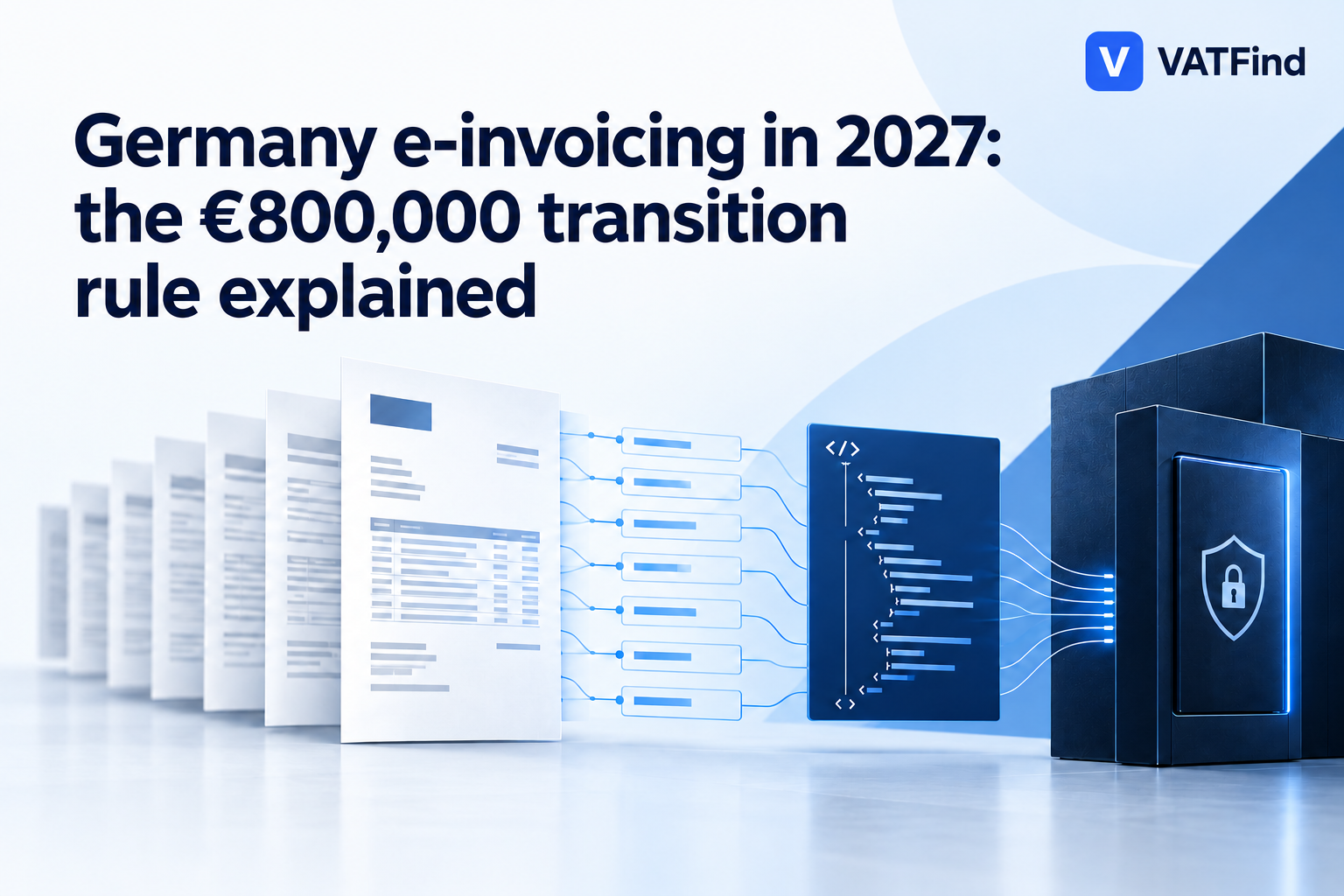
Germany did not postpone e-invoicing to 2027: the new legal definition and receiving requirement have applied since 1 January 2025. What changes on 1 January 2027 is the end of the broad paper and ordinary-PDF transition. Issuers above the €800,000 preceding-year turnover threshold lose that general fallback; smaller issuers and certain EDI arrangements retain a final transition year. Enterprise teams should classify each transaction by supply date and exact issuing entity, preserve the original structured file, and keep format validity, supplier identity, VAT evidence and payment approval as separate decisions.
What actually changes on 1 January 2027
Germany’s e-invoicing rules are already in force. The Growth Opportunities Act revised section 14 of the German VAT Act for supplies carried out after 31 December 2024, and the new definition has applied since 1 January 2025. Under that definition, an electronic invoice is a structured electronic document that can be processed electronically. A conventional PDF is classified as an “other invoice”, even though it is delivered digitally.
The operational break on 1 January 2027 comes from the transition provisions, not from a new mandate being adopted on that date. Section 27(38)(1) permits every issuer to use paper, or a non-structured electronic format with the recipient’s consent, for supplies performed from 1 January 2025 through 31 December 2026. That broad permission expires at the end of 2026.
For supplies performed during 2027, the fallback splits by issuer. An entrepreneur whose total turnover in the preceding calendar year did not exceed €800,000 may continue using paper or, with recipient consent, an ordinary electronic format until 31 December 2027. A non-qualifying EDI arrangement also receives a separate transition through 2027. An issuer above the turnover threshold cannot rely on the small-issuer extension for an in-scope domestic B2B supply.
The exact dates must remain distinct. The law was promulgated in March 2024; the revised invoice rules began to apply on 1 January 2025; the Ministry refreshed its FAQ on 23 March 2026; the broad transition ends on 31 December 2026; the final turnover and EDI transitions end on 31 December 2027. None of those milestones should be described as a proposal or consultation.
Germany’s e-invoicing rollout is a sequence, not a single go-live
Six legal and administrative milestones separate adoption, current application, updated guidance and the two transition cutovers.
- 0127 Mar 2024
Growth Opportunities Act promulgated; the legal change is adopted.
- 021 Jan 2025
Structured-invoice definition and receiving capability apply to relevant supplies.
- 0315 Oct 2025
Second Federal Ministry of Finance administrative letter is issued.
- 0423 Mar 2026
Federal Ministry of Finance updates its operational FAQ.
- 051 Jan 2027
Broad paper/PDF transition has ended; the €800,000 issuer test becomes decisive.
- 061 Jan 2028
Turnover-based and non-qualifying EDI transitions have ended.
The €800,000 test belongs to the invoice issuer
The most common interpretation error is to apply the €800,000 threshold to the buyer, the value of the invoice or the supplier’s global group. Section 27(38)(2) refers to the total turnover, calculated under section 19(2), of the entrepreneur issuing the invoice in the preceding calendar year. The legal entity and the relevant year must therefore travel with the decision.
For a supply performed in 2027, the relevant turnover period is generally 2026. A multinational buyer may receive a qualifying structured invoice from one German supplier and a legally permitted PDF from another, even where the purchases look identical. The difference is the exact issuing entrepreneur’s statutory position, not the buyer’s procurement category or risk tier.
The buyer will not always hold the supplier’s statutory turnover calculation. That creates a governance question rather than permission to guess. For suppliers that continue sending ordinary PDFs during 2027, procurement or accounts payable should define proportionate evidence: the issuing legal entity, the calendar year tested, the asserted turnover band, the person making the assertion, the date and the expiry. A permanent “small supplier” flag is not defensible because legal entities, ownership and turnover can change.
Avoid demanding audited accounts from every supplier simply to receive an invoice. The evidence burden should be proportionate to invoice volume, materiality and the risk of disruption. But an unrecorded email or a group-level sales estimate is not a repeatable control. The status should expire before the 2028 cutover or earlier if the billing entity changes.
The transition window differs by issuer cohort
Months for which the statutory transition permits paper or a non-structured format, measured from 1 January 2025.
Who is affected—and which invoices can remain outside the structured rule
The core issuing duty concerns supplies from one entrepreneur to another entrepreneur for the recipient’s business where both parties are established in Germany within the statutory test. Establishment can arise through a registered office, place of management or a fixed establishment involved in the transaction. German VAT registration by itself does not automatically make a foreign business German-established for this purpose.
The Federal Ministry of Finance says that a foreign entrepreneur registered for German VAT but without a German fixed establishment may state that fact on the invoice. A recipient exercising ordinary commercial care may rely on that statement. In enterprise systems, that conclusion should not be stored as a timeless country flag: it is a transaction-linked assertion about the issuing entity and the establishment involved in the supply.
Consumer invoices are outside the domestic B2B rule, and many VAT-exempt supplies listed in section 4(8)–(29) do not create the same VAT invoice duty. Separately, the Ministry identifies cases where an invoice may remain an “other invoice” even where an invoice is required: qualifying low-value invoices up to €250 gross, tickets treated as invoices, supplies by entrepreneurs using the small-business exemption, supplies to legal persons not acting as entrepreneurs and specified property-related supplies to consumers.
“Outside the B2B mandate” does not mean “no invoice obligations”. VAT, civil-law, sectoral and public-procurement requirements can still apply. Germany’s B2G rules also operate alongside the VAT rules rather than underneath them. A transaction may have a VAT transition right yet still need an electronic invoice because the customer is a public authority and a separate procurement rule applies.
- Use supply date as a controlling field; invoice receipt date alone is insufficient.
- Separate German establishment from German VAT registration.
- Bind every exception to the exact supplier, transaction type, reason and effective period.
- Distinguish B2B VAT rules from B2G channel and threshold requirements.
- Represent uncertain cases as review states, not as a generic PDF-allowed flag.
The recipient cannot wait until 2027
German-established businesses have needed to be able to receive an e-invoice since 1 January 2025. The Ministry says there are no general recipient-side exceptions to that capability, including for entrepreneurs using the small-business regime. An email inbox is sufficient as a minimum transport channel. That is a legal floor, not an adequate enterprise operating model.
An inbox does not explain whether the structured file is quarantined, scanned, validated, rendered, matched to a purchase order, compared with supplier master data, posted, routed for approval and archived without alteration. It also creates a human-factors problem: a reviewer may approve a familiar PDF image while the accounting system consumes different values from an embedded XML file.
For a hybrid invoice such as a qualifying ZUGFeRD document, the structured data is the leading component when it conflicts with the visual layer. The Ministry recommends independently visualising the XML. Accounts payable should therefore show reviewers the fields that will actually be booked—supplier, recipient, tax identifier, invoice number, issue date, supply date, taxable amount, VAT rate, VAT amount, currency, buyer reference and payment instructions—and raise a controlled exception when the visual and structured layers diverge.
The original payload should remain immutable. Rendering, normalisation and mapping are processing steps with their own versions and timestamps. If a supplier sends a PDF by email and the same liability through a structured channel, shared deduplication is essential; otherwise the migration can create duplicate obligations rather than remove manual work.
XRechnung, ZUGFeRD, PDF and EDI do not have the same legal status
Germany’s domestic B2B VAT rule does not prescribe one transmission network. The Ministry lists email, an electronic interface, shared access to a central storage location, physical media and portal download as possible transport methods. The parties still need a workable commercial channel, but delivery over a digital channel does not make the document a qualifying e-invoice.
The central legal question is structure. Section 14 requires a structured electronic format that enables electronic processing. One route is conformity with the European e-invoicing standard and the syntaxes referenced under Directive 2014/55/EU. Another is an agreed format from which the VAT-required information can be extracted correctly and completely into, or interoperably with, an EN 16931-compliant format.
The Ministry identifies XRechnung and ZUGFeRD from version 2.0.1, excluding the MINIMUM and BASIC-WL profiles, as formats that meet the VAT requirements. XRechnung is structured XML without an inherent visual PDF. A qualifying ZUGFeRD file combines structured XML with a human-readable PDF/A-3 layer. That hybrid presentation can help users, but it does not reverse the precedence of the XML when the layers disagree.
Validation is useful but it is not the complete legal decision. A validator can detect malformed XML, missing mandatory elements or inconsistent business rules. The Ministry states that validation is not itself an immediate condition for tax recognition. It also cannot establish that the supplier is the intended legal entity, that the VAT identifier belongs to that entity or that a bank-account change is authorised.
Document-format status across the German transition
The format decision changes in 2027 by issuer cohort and changes again when the final transition ends in 2028.
| Format | 2026 | 2027 >€800k | 2027 ≤€800k | 2028 |
|---|---|---|---|---|
| XRechnung / EN 16931 XML | Qualifies | Qualifies | Qualifies | Qualifies |
| Qualifying ZUGFeRD hybrid | Qualifies | Qualifies | Qualifies | Qualifies |
| Ordinary PDF | General transition | No general transition | Turnover transition | No transition |
| Non-qualifying legacy EDI | General transition | EDI transition | EDI transition | No transition |
Structured invoicing makes supplier identity a stronger dependency
Structured invoices reduce rekeying, but they also move unreliable master data faster. If the wrong legal entity, VAT identifier or address is embedded in XML, automated systems can reproduce that error across posting, tax reporting, payment approval, audit evidence and analytics before a person sees it.
Section 14 requires the full name and address of supplier and recipient, the supplier’s tax number or VAT identification number, issue date, unique invoice number, description, supply date, taxable amount, VAT rate and VAT amount or exemption reference. The Ministry says all VAT-required information must appear in the structured part; a pointer to an unstructured attachment is not enough for a legally required field.
Procurement and accounts payable should compare the supplier legal name in XML with the approved vendor master, resolve the relevant company or registry identifier, associate the VAT ID with the same legal entity, compare the address with onboarding evidence, authenticate payment details independently and confirm that the purchase order uses the same contracting entity.
These are separate claims. A file can be structurally valid while containing an unknown VAT ID. A VAT ID can relate to a real group company while the invoice names another entity. The supplier can be correctly identified while newly changed bank details remain unapproved. One green badge cannot explain those differences to an auditor or a payment approver.
If VIES or another authority service is used, keep the submitted number, normalised number, response, source, time and any reference as a separate evidence object. An invalid result, unavailable service or name mismatch requires the workflow to distinguish input, registration, service and identity issues. None of those outcomes proves that a company is fictitious.
- Legal entity match: does the invoice identify the approved contracting supplier?
- VAT evidence: what did the relevant authority service return, and when?
- Format validity: does the document meet the applicable structure and business rules?
- Commercial match: does it agree with the purchase order and receipt or service approval?
- Payment approval: are beneficiary and bank details independently authorised?
SUPPLIER IDENTITY CONTROL
Resolve the German supplier before accepting its invoice data.
Find a VAT number by company name or match a supplied VAT number to the legal company record. Keep that company evidence separate from format validation and any authority-status response.
A practical enterprise operating model
Start with transaction scope. The rules engine should evaluate supplier establishment, recipient establishment, business purpose, supply date, invoice requirement, exemption category, gross amount, issuer small-business status, issuer preceding-year turnover band and any separate B2G obligation. Its output should be a reasoned state—structured required, transition allowed, other-invoice exception or outside domestic B2B scope—not a free-text note.
Then validate the original document before posting. Quarantine unsafe files, preserve the received payload, calculate an integrity hash, extract the structured data and record the validator version and time. Separate fatal structural errors from non-fatal warnings and from business mismatches. The supplier owns content corrections; the transport provider owns delivery faults; tax owns scope; the ERP team owns mapping; accounts payable owns purchase-order and receipt exceptions.
Resolve the company and tax identifiers before permitting straight-through processing. Normalise identifiers without discarding what the supplier submitted. Link each response to its source and timestamp. A cached company-data record, a registry record and an authority VAT response answer different questions and should never be relabelled as one another.
Match commercial and payment evidence only after the document and entity are understood. A valid XML schema should not bypass three-way matching, duplicate detection, segregation of duties or bank-change authentication. Finally, archive the original structured invoice, relevant attachments, validation evidence, processing events and corrections. The Ministry states that at least the structured component must be retained intact in its original form for the eight-year VAT retention period.
The six-control German e-invoice lifecycle
Each stage produces different evidence and has a different failure owner; passing one stage does not approve the next.
- 01Scope
Establishment, transaction, invoice duty and supply date.
- 02Cohort
Issuer turnover, exception evidence and expiry date.
- 03Structure
Original payload, syntax and business-rule validation.
- 04Identity
Legal entity, address, VAT ID and source lineage.
- 05Match
PO, receipt, duplicate, beneficiary and approval controls.
- 06Archive
Original structured file and processing evidence retained.
The evidence record should survive a vendor change
Require exports of the original file, validation output, transformation version, sender and recipient identifiers, transmission and receipt times, acknowledgements, exception history, manual overrides and posting outcome. A platform screenshot is not a durable audit record. Contracts should state how evidence is returned if the service ends and how long it remains available after termination.
How Germany e-invoicing implementations fail
The largest risks sit between legal scope, supplier master data and invoice operations. A successful test transmission proves only that one file reached one endpoint. It does not prove the programme can classify every supplier, absorb corrections, reconcile hybrid data, prevent duplicate booking or preserve defensible evidence during an outage.
1. Treating 1 January 2027 as a universal big bang
Hard-rejecting every PDF can stop legitimate supplier payments because smaller issuers and certain EDI flows retain transition routes through 2027. The inverse failure is allowing every PDF because some suppliers qualify. That turns a narrow, expiring transition into an uncontrolled bypass.
- Control: calculate scope per invoice and require a time-limited reason code for every non-structured document accepted after 31 December 2026.
2. Applying the €800,000 threshold to the buyer or group
The statutory test concerns the invoice issuer’s preceding-year total turnover. Buyer revenue, contract value, employee count or group-level assumptions can put the invoice into the wrong route.
- Control: bind turnover evidence to the exact billing legal entity, the relevant calendar year and an expiry date.
3. Validating only the visual PDF layer
In a hybrid invoice, the structured component is leading when it conflicts with the image. A reviewer can approve an attractive PDF while the ERP books different XML values.
- Control: render the structured data independently, compare critical fields and make divergence a reviewable exception.
4. Confusing transport with compliance
Email delivery, a portal receipt or an EDI acknowledgement proves neither legal format validity nor supplier identity. Marking the invoice complete at the gateway hides downstream failure.
- Control: keep transport receipt, structural validation, identity match, posting and payment as separate states.
5. Testing one happy-path invoice
Construction bills, credit notes, advance payments, final invoices, self-billing, factoring, mixed rates and large attachments expose mapping and ownership gaps that a single standard invoice will not reveal.
- Control: test real invoice families, corrections, rejected files, resubmissions and duplicate replays before acceptance.
6. Archiving a rendering instead of the source
A PDF view is useful for people but can omit structured values and processing metadata. Recreating XML from a rendering later is not equivalent to retaining the original document.
- Control: preserve the original structured file intact with attachments, validation evidence and linked corrections.
7. Letting transition logic become permanent master data
Supplier turnover, establishment and small-business status can change. An undated master-data flag can survive beyond the legal transition and silently authorise the wrong format.
- Control: store source, effective period, reviewer and next-review date; remove all turnover-based transition logic for supplies from 1 January 2028.
A 90-day readiness plan for finance, tax, procurement and data teams
The purpose of a 90-day plan is not to declare the programme finished. It is to turn a legal deadline into a testable operating model with named owners, representative invoice traffic and measurable exceptions. Start with the largest German invoice flows and the suppliers most likely to rely on 2027 transitions.
Days 1–30: establish scope and ownership
Appoint one accountable programme owner across tax, finance operations, procurement, ERP, security and records management. Inventory every German billing and receiving entity, fixed establishment, invoice channel and ERP instance. Segment suppliers by invoice volume, format and expected transition status. Define the authoritative supply-date field and approve reason codes for every non-structured path.
- Identify contracts that still prescribe paper, PDF, portal or legacy EDI delivery.
- Map which team owns supplier establishment, turnover evidence and exception approval.
- Measure current invoice counts by format, channel, legal entity and manual-touch rate.
Days 31–60: build and test controls
Test representative XRechnung and qualifying ZUGFeRD samples, including corrections and credit notes. Confirm that every VAT-required field is in the structured portion. Implement XML-versus-PDF divergence alerts, link intake to legal-entity and VAT evidence, and test quarantine, rejection, supplier notification and resubmission.
- Confirm that the archive retains the original structured payload and attachments.
- Test duplicate detection across email, portal and structured channels.
- Make manual overrides exportable with reason, reviewer, time and evidence.
Days 61–90: prove the operating model
Run parallel processing with the largest German suppliers and highest-volume invoice families. Track rejection reasons, unresolved identity conflicts, manual touches and average exception age. Obtain time-limited turnover assertions only where a 2027 PDF route is expected. Simulate malformed XML, transport failure and duplicate replay.
- Train reviewers on which data layer controls in a hybrid invoice.
- Test the supplier escalation route, not only the internal ticket queue.
- Schedule removal of the €800,000 transition path for supplies from 1 January 2028.
Questions enterprise buyers should ask vendors and suppliers
Procurement should turn regulatory claims into acceptance criteria. A provider that says it is “Germany-ready” should identify the exact formats, profiles, rule sets, evidence exports and exception workflows it supports today. Anything dependent on future German reporting legislation should be labelled as roadmap, not delivered compliance.
Questions for an e-invoicing or AP vendor
The strongest answers include a live demonstration, an exportable evidence record and named version support rather than a general assurance.
- Which XRechnung and ZUGFeRD versions and profiles are supported, and how quickly are new releases added?
- Does validation test syntax only, or also EN 16931 business rules and applicable German rules?
- How are original files, embedded XML, visual layers and attachments preserved?
- Can the interface expose differences between a hybrid invoice’s XML and image layer?
- Can policy decisions use supply date, exact supplier entity, turnover evidence and exception expiry?
- Are transport, validation, identity, posting and payment statuses separately reportable?
- How are duplicate submissions across email, portal and EDI channels detected?
- Can all evidence and manual overrides be exported when the contract ends?
Questions for suppliers still using PDF or legacy EDI
Ask the supplier to explain the route it expects to use without turning procurement into a tax-advice service. The buyer needs enough evidence to operate its own intake policy.
- Which exact legal entity will issue invoices for supplies performed in 2027?
- Is that entity established in Germany or using a German fixed establishment involved in the supply?
- Which structured format, version and profile will it send?
- Which channel will carry invoices, corrections and rejection responses?
- If it expects to continue PDF, which statutory transition or exception is it relying on?
- If it relies on the €800,000 transition, which legal entity and calendar year does the assertion cover?
- Who owns correction of invalid XML or inconsistent invoice data?
- How will bank-detail changes be authenticated outside the invoice itself?
The enterprise decision: redesign the control, not just the file
Germany’s 2027 milestone is a control redesign. Structured invoices can reduce rekeying and accelerate matching, but automation multiplies the consequences of poor entity data, incorrect tax identifiers and weak exception governance. The economic benefit only appears when the document can move through a reliable, evidence-backed process.
A defensible design keeps five conclusions separate: transaction scope, format validity, supplier identity, authority VAT evidence and payment approval. A supplier can pass one and fail another. That separation gives tax, procurement, AP and audit a shared record without pretending that XML validation makes the entire transaction compliant or safe to pay.
For global groups, Germany should be one country policy inside a reusable control framework. France, Poland and other markets use different networks, clearance models, reporting duties and outage rules. The common layer is company and invoice identity: who supplied, who bought, which identifier was submitted, what source supported it, when it was checked and what changed before payment.
The immediate management test is concrete: can the business explain why a PDF received for a 2027 supply was accepted, identify the issuing legal entity, show the time-bound evidence for the exception, prove which data layer was booked and retrieve the original document? If not, the programme is not ready even if the gateway can receive XML.
- List every German entity that issues or receives B2B invoices.
- Map supply date, not only invoice date and receipt date.
- Separate German establishment from German VAT registration.
- Record turnover-transition evidence against the exact issuing entity.
- Add expiry dates to every 2027 transition override.
- Support qualifying XRechnung and ZUGFeRD profiles.
- Preserve the original structured invoice intact for the required retention period.
- Show the structured data to reviewers and flag visual differences.
- Keep company identity, authority VAT evidence and format validation separate.
- Test credit notes, corrections, self-billing, advances and final invoices.
- Set a hard removal date for turnover-based transition logic on 1 January 2028.
- Review current official guidance before changing production tax logic.
GLOBAL VENDOR MASTER
Apply the same entity-control model to US suppliers.
Find an EIN by company name and match it to the intended US legal entity, without presenting company association as IRS TIN Matching or an IRS status check.
PRACTICAL ANSWERS
Frequently asked questions
Is e-invoicing mandatory in Germany in 2027?
For many domestic B2B supplies, yes. The broad paper and ordinary-PDF transition ends on 31 December 2026. Issuers whose preceding-year total turnover exceeds €800,000 generally need a qualifying structured e-invoice for in-scope supplies from 1 January 2027. Smaller issuers and certain EDI arrangements retain a transition through 2027.
Does Germany require Peppol for domestic B2B e-invoices?
No single B2B transmission network is prescribed by the VAT rule. The Ministry lists email, interfaces, shared storage, physical media and portal download as possible routes. Separate contracts or B2G requirements can still prescribe a channel.
Is an ordinary PDF an electronic invoice in Germany?
An ordinary PDF is an ‘other invoice’, not an e-invoice under the post-2024 definition, because it is not a structured format enabling electronic processing. It can still be permitted during an applicable transition or under a specific exception.
What is Germany’s €800,000 e-invoicing threshold?
It is the invoice issuer’s total turnover in the preceding calendar year under the statutory definition. It is not the invoice value, the buyer’s turnover, employee count or automatically the supplier group’s consolidated revenue.
Must small German businesses receive e-invoices?
Yes. The Ministry says German-established businesses, including entrepreneurs using the small-business regime, have needed to be able to receive e-invoices since 1 January 2025. An email inbox is sufficient only as a minimum receiving channel.
Which German e-invoice formats qualify?
The Ministry identifies XRechnung and ZUGFeRD from version 2.0.1, excluding MINIMUM and BASIC-WL profiles, as formats that satisfy the VAT requirements. Other formats may qualify if they meet the statutory extraction and interoperability conditions.
Which part of a ZUGFeRD invoice controls if XML and PDF disagree?
The structured component controls for VAT purposes under the new regime. The Ministry recommends independently visualising the XML because the human-readable image is not the leading component when values conflict.
Are invoices up to €250 exempt from structured e-invoicing?
A qualifying low-value invoice whose gross total does not exceed €250 may be transmitted as an other invoice under section 33 UStDV. The exception does not cover every transaction category, so its underlying conditions still need to be checked.
How long must German e-invoices be retained?
The VAT Act requires copies of incoming and outgoing invoices to be retained for eight years. For an e-invoice, at least the structured component should be preserved intact in its original form.
Does a valid German e-invoice prove the supplier’s VAT status?
No. Format validation assesses document structure and business rules. Legal-entity identity, VAT-number association, current authority status and payment approval are separate controls supported by separate evidence.