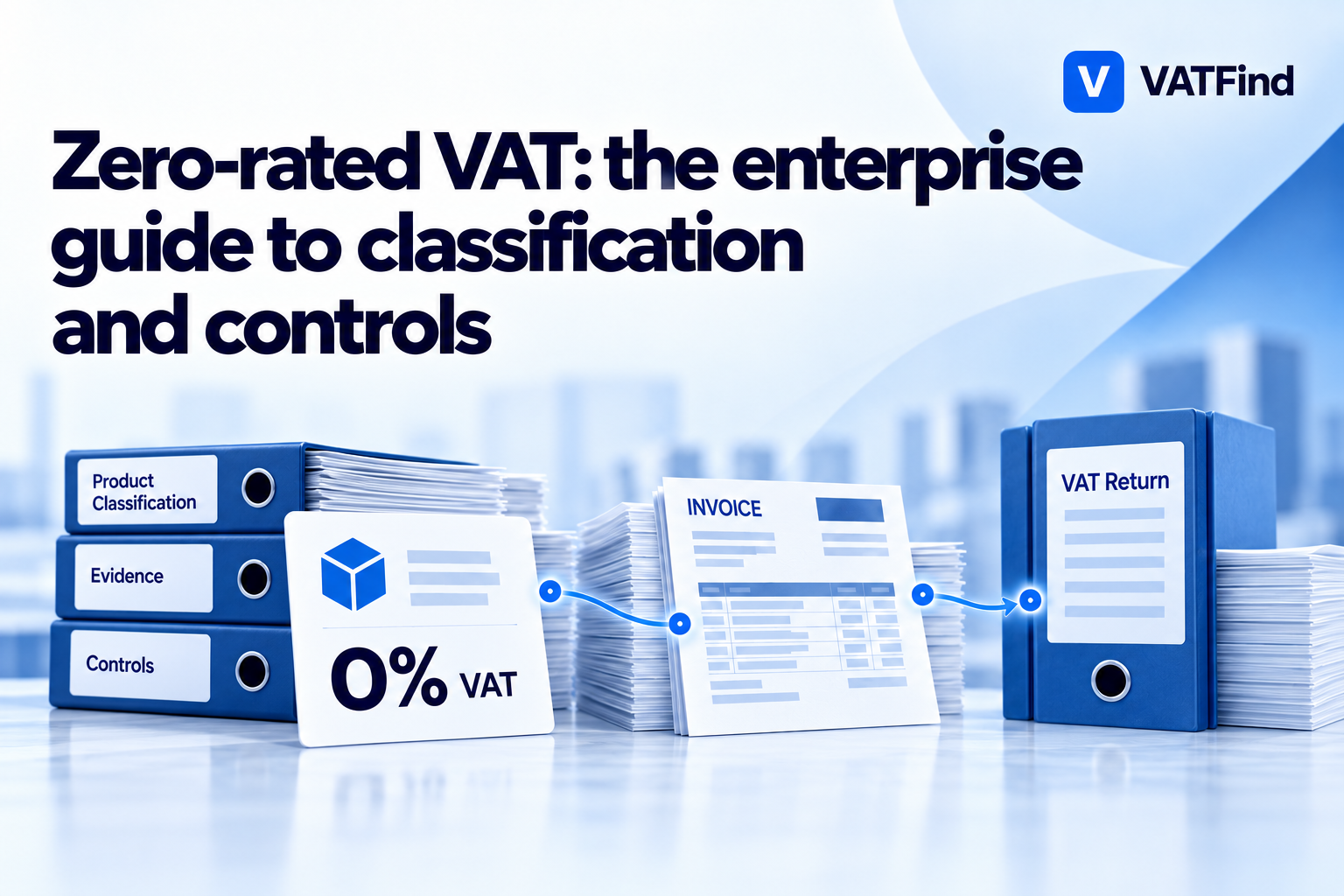
A zero-rated supply is still taxable, but at 0%. That distinction preserves the supplier's normal right to recover related input tax and keeps the sale inside VAT records and returns. Enterprise control should therefore prove the exact legal category, conditions, parties, location, evidence and effective date before a 0% tax code is applied—and should keep zero-rated, exempt and outside-the-scope outcomes separate.
What zero-rated VAT means in the UK
Zero-rated VAT is the UK VAT treatment for specified taxable supplies charged at 0%. The customer pays no VAT on the sale, but the transaction remains a taxable supply. Subject to the ordinary recovery conditions, the supplier can normally deduct input VAT incurred in making it. This is why a zero VAT rate is not interchangeable with exemption, non-business activity or a transaction that falls outside the scope of UK VAT.
The legal route starts with section 30 of the Value Added Tax Act 1994 and Schedule 8. Schedule 8 groups the goods and services that Parliament has placed in the zero rate, while detailed HMRC notices explain how the statutory descriptions apply in practice. The list is not a permission to classify by a short product label. Food, printed matter, clothing, construction, exports, transport and reliefs each contain conditions, exclusions and boundary cases.
For enterprise systems, the rate field is the end of the decision, not the beginning. A product may be zero-rated only when its physical characteristics, use, packaging, customer, destination or supporting evidence meet a particular rule. The same commercial catalogue can contain 0%, 5% and 20% items. A bundled sale can also require a single-supply or multiple-supply analysis instead of inheriting the rate of the most visible component.
This guide reflects UK rules and guidance checked on 30 September 2026. It is an operating framework rather than personalised tax advice. Teams should map each material supply population to the current legislation and relevant HMRC notice, record the basis used, and obtain specialist advice where the facts or authority are uncertain.
Zero-rated VAT is not the same as exempt VAT
A zero-rated sale and an exempt sale can both produce an invoice with no VAT collected from the customer, but their economics and reporting are different. Zero-rated sales form part of taxable turnover. Related input tax is normally recoverable, subject to the usual conditions and restrictions. Exempt sales are not taxable supplies at a VAT rate, and input tax directly attributable to them is generally not recoverable unless a specific rule provides otherwise.
The distinction affects registration, partial exemption, cash flow, pricing and data design. A business with mainly zero-rated sales may regularly recover more input tax than it accounts for as output tax and therefore submit repayment returns. A partly exempt business may need to attribute and apportion costs. Treating both outcomes as a generic 'no VAT' code destroys the information needed for that calculation.
Outside-the-scope activity is different again. It can describe transactions or activities to which UK VAT does not apply, but the reason matters. A supply outside the UK place-of-supply rules, a non-business payment and a statutory fee are not one tax category simply because no UK VAT is charged. Each outcome needs its own code, evidence and return mapping.
The reduced and standard rates also remain taxable rates. HMRC's published UK rate guide uses 5% for qualifying reduced-rate supplies and 20% for the standard rate, while Schedule 8 supports the zero rate. The correct control is therefore a classification hierarchy: determine whether there is a supply and whether UK VAT applies, then identify the statutory liability and test every condition attached to it.
Five outcomes that must not share one tax code
The customer charge can look similar while recovery and reporting differ materially.
| Treatment | Customer VAT | Taxable supply? | Related input VAT | Control implication |
|---|---|---|---|---|
| Standard rate | 20% in the ordinary UK case | Yes | Normally recoverable when conditions are met | Prove liability, value and tax point |
| Reduced rate | 5% for qualifying supplies | Yes | Normally recoverable when conditions are met | Prove the reduced-rate conditions |
| Zero rate | 0% | Yes | Normally recoverable when conditions are met | Retain category-specific eligibility evidence |
| Exempt | No VAT rate charged | No | Generally restricted for directly related costs | Feed partial-exemption and registration logic |
| Outside scope | No UK VAT | Depends on the reason | Depends on the underlying rule | Keep reason-specific codes and evidence |
The six gates for a zero-rating decision
A defensible classification starts with the supply, not a keyword in the product description. First, establish what is supplied. A contract may contain goods, services, licences, delivery, installation or several elements. Decide whether those elements form one supply or multiple supplies before assigning rates. A product called a book may be a zero-rated publication, a standard-rated stationery item or part of a wider digital service depending on its characteristics and contractual reality.
Second, identify the legal route. Link the decision to the relevant Schedule 8 group, statutory item and HMRC guidance. Third, test the product or service conditions. For children's clothing, the four published conditions include the article type, material, design and suitability. For food, composition, temperature, catering context, packaging and how the item is held out for sale can change the result.
Fourth, test the customer, use and location conditions. Some reliefs depend on the eligible customer or intended use. Export zero rating depends on goods leaving the relevant territory and on the export conditions, not merely on a customer's foreign address. Fifth, test the evidence and time limit. A substantively eligible export can lose zero-rating treatment when the supplier fails to obtain acceptable evidence in time.
Sixth, confirm the accounting output. The invoice should show the correct rate and required details, the sale should reach the correct return boxes, and the evidence should remain connected to the transaction. A reviewer should be able to reproduce the decision without searching email archives or relying on the employee who created the tax code.
Zero-rating: six controlled gates
Apply 0% only when the relevant path is complete or an authorised exception is documented.
- 01Supply
Identify the actual goods, services and any bundled elements.
- 02Legal route
Map to the applicable Schedule 8 group and current guidance.
- 03Conditions
Test product, service, design, presentation and use requirements.
- 04Parties and place
Confirm the supplier, customer, destination and territorial rule.
- 05Evidence and time
Hold the required proof within the applicable period.
- 06Accounting
Issue the invoice, post the code and map the return consistently.
VAT zero-rated supplies need category-specific evidence
There is no universal 'zero-rated item' certificate. Each category answers a different factual question. Food rules examine the product and how it is supplied. Printed-matter rules examine form, function and content. Children's clothing rules examine design and suitability. Export rules examine movement, timing and evidence. A generic supplier declaration may support a review, but it does not replace the business's responsibility for the VAT treatment it applies.
Most food for human consumption is zero-rated, but HMRC lists important standard-rated exceptions and separate catering rules. Mixed packs require particular attention. Notice 701/14 explains that a minor standard-rated linked item can follow the zero-rated main item only when the stated conditions are met, including cost limits. Product information therefore needs composition, pack structure, serving state and presentation—not just a merchandising category.
Books and qualifying printed matter fall within Schedule 8 Group 3. HMRC's Notice 701/10 distinguishes books, booklets, brochures, pamphlets, leaflets and certain electronic publications from stationery, products mainly for completion and other excluded items. The extension to qualifying e-publications from 1 May 2020 did not make all digital content zero-rated. Audio, video, software and advertising-heavy products need separate analysis.
Young children's clothing and footwear can be zero-rated when the four conditions in Notice 714 are met. Size alone is not a perfect control: design, labelling, marketing and suitability matter. Protective equipment follows separate rules. The operational model should therefore attach the decision to a defined product version and evidence set, not permanently to a broad brand or supplier.
Four common zero-rating populations, four evidence models
A shared 0% outcome does not mean a shared legal test.
| Population | Principal test | Useful evidence | Common control failure |
|---|---|---|---|
| Food and drink | Composition, serving context, exclusions and presentation | Specification, ingredients, pack design, temperature and sales channel | A broad food category overrides catering or exception rules |
| Books and publications | Form, function, content and qualifying electronic format | Product file, sample, content mix, format and version | Every digital publication inherits the print rate |
| Children's clothing | Article, material, design and suitability conditions | Measurements, design file, labels, images and marketing | Age or supplier code is accepted without suitability evidence |
| Exports of goods | Actual export plus conditions, timing and acceptable proof | Order, invoice, transport record, customs record and payment | Foreign customer address is treated as proof of export |
Master data must preserve the reason for 0% VAT
A tax engine can apply a zero rate consistently and still be consistently wrong. The quality of the result depends on the product, customer, entity, location and evidence fields that drive the rule. Enterprise teams should separate stable attributes from transaction-specific facts. Product composition may remain stable for a version; delivery destination, customer use and export evidence belong to the transaction.
Create a liability record with a legal basis, jurisdiction, effective-from date, effective-to date, evidence owner and review trigger. Store the tax code as an output. When a recipe, format, size range, packaging, bundle or sales channel changes, route the product for reassessment. Do not overwrite the historical classification: invoices already issued need the rule and facts that applied on their tax point.
Customer identity matters where eligibility, relief or place depends on the buyer. Resolve the contracting party to a legal entity and keep company registration and VAT identifiers separate. A valid-looking VAT number does not prove entitlement to a particular zero rate, while an unavailable validation response does not prove the customer is fictitious. Record the check, source, timestamp and match decision as one evidence layer.
Supplier data matters on the purchase side as well. A business making zero-rated sales can normally recover related input VAT, but only when the ordinary recovery requirements are met. The purchase invoice must belong to the claimant and represent a genuine business supply. Zero-rated turnover does not turn weak supplier documents into deductible input tax.
VAT NUMBER RESEARCH
Check the company behind a VAT number
Use VATFind to research company and tax-identifier records, then retain the result inside the wider classification and evidence process.
Invoice and VAT Return controls for a zero VAT rate
A zero-rated invoice should still carry the details required for the applicable VAT invoice type and show the 0% treatment clearly. Do not omit the sale from VAT records because the output tax amount is zero. Under ordinary UK VAT Return mechanics, the net value of taxable sales contributes to box 6, while qualifying purchase values and deductible input tax follow their relevant boxes and rules.
Illustrative example: a UK company sells £100,000 of qualifying zero-rated goods and buys £60,000 of standard-rated inputs plus £12,000 VAT. If every recovery condition is met and there are no other transactions, the company accounts for £0 output VAT on the sales, reports the taxable sales value and can deduct £12,000 of input VAT. The return can therefore be in a repayment position. The commercial margin does not create the repayment; the different treatment of outputs and recoverable inputs does.
Now compare an otherwise identical exempt-sales scenario. The customer still pays no VAT, but input tax directly attributable to exempt supplies is generally restricted. The £12,000 can become a cost unless partial-exemption or another rule permits recovery. This is why a one-character coding error between Z and E can materially alter cash, margin and the VAT Return even though the customer invoice total is unchanged.
Reconcile zero-rated sales by legal entity, tax code, product family, country, channel and evidence status. Review negative values, unusual manual overrides, zero-rated sales with no supporting legal route, products switching repeatedly between 0% and 20%, and exports whose evidence remains open after the deadline. Value-weighted exception reporting is usually more informative than transaction counts alone.
Export zero rating fails when evidence and timing are detached
Exports are a frequent enterprise failure point because the tax decision occurs before the complete evidence pack exists. HMRC says goods exported from Great Britain to a destination outside the UK can normally be zero-rated when the conditions are met. For Northern Ireland, movements involving EU destinations follow a different framework. The customer address or incoterm alone does not decide the treatment.
The evidence must establish both the supply and the goods' departure. HMRC accepts official or commercial evidence, but the documents need to form a consistent audit trail. An export declaration, carrier record or goods-departed message should connect to the customer order, invoice, dispatch, payment and product. A warehouse scan that cannot be matched to the invoiced goods does not complete the chain.
The ordinary evidence window is three months from the relevant time of sale, with specific extensions for certain circumstances. If the goods are not exported or acceptable evidence is not obtained within the period, the supplier must not leave the transaction zero-rated and should account for VAT as required. HMRC's internal manual also explains that a later export or later evidence can allow an adjustment when the conditions are satisfied.
Operationally, create provisional and confirmed evidence states without pretending that provisional means legally complete. Start the evidence clock from the correct event, assign an owner, chase the carrier or customer before expiry, and post the required adjustment when the deadline is missed. If evidence later arrives, link the correction to the original transaction instead of creating a disconnected credit-and-rebill trail.
Export zero-rating evidence lifecycle
Four control points from sale to correction under the ordinary UK evidence process.
- 011. Sale and tax point
Create the order, invoice and shipment link; identify the exporter and territorial route.
- 022. Goods leave
Capture the physical movement and match customs or carrier records to the invoiced goods.
- 033. Evidence window
Obtain and retain acceptable official or commercial evidence, ordinarily within three months.
- 044. Exception or correction
If conditions are missed, account for VAT; if qualifying evidence later arrives, use the supported adjustment route.
How enterprise zero-rating controls fail
The first failure is a universal zero-rate code. It records the outcome but not the reason, so nobody can tell whether the sale concerns food, exports, books, clothing or another relief. When a rule changes, the business cannot identify the affected population. Replace the universal code with reason-specific liability records even if several records post to the same accounting rate.
The second is classification by supplier or brand. A food supplier can sell standard- and zero-rated products; a publisher can sell qualifying books, stationery and software. The third is classification by product description alone. Names are marketing language, not legal evidence. Use controlled attributes and retain the specification or sample reviewed.
The fourth is a permanent decision with no effective date. Products, packaging, customer use, legislation and HMRC policy can change. The fifth is accepting a foreign customer address as proof of export. The sixth is collapsing unavailable, missing and failed evidence into one status. Those conditions require different action: retry a service outage, obtain a missing document, or correct the tax treatment when the rule is not met.
The seventh is testing only the happy path. A system demonstration with one perfect invoice does not show how it handles mixed-rate bundles, credit notes, evidence received late, a product-version change, a customer-entity mismatch or a manual override. The eighth is outsourcing tax judgement to an opaque score. A provider should return the source facts and evidence; the business must still govern the legal interpretation and correction path.
- No legal basis or evidence owner attached to the 0% decision.
- One tax code used for zero-rated, exempt and outside-the-scope outcomes.
- Product changes do not trigger reassessment.
- Export evidence cannot be linked to the order and invoice.
- Manual overrides are not time-limited or reviewed.
- Corrections overwrite history instead of preserving the decision chain.
A practical zero-rated VAT implementation checklist
Start with a transaction inventory. Segment sales by legal entity, jurisdiction, product or service family, customer type, channel and current tax code. For each zero-rated population, identify the statutory route, notice, required attributes, evidence, deadline, invoice treatment, return mapping and control owner. Include credits, bundles, free supplies, imports and intercompany transactions where they occur.
Then test representative and adverse cases. Use current product versions and synthetic failures where necessary: a hot-food sale, an e-publication mainly for completing, children's clothing outside the published sizing evidence, an export with no departure confirmation, a foreign address with UK delivery, a mixed hamper, a late carrier document and a tax code changed manually after invoicing. Confirm that the system pauses or corrects the transaction without deleting the original facts.
Finally, measure the exceptions that expose economic risk. Monitor the value of zero-rated sales lacking complete evidence, evidence approaching expiry, overrides by user and reason, product changes awaiting review, recurring supplier or customer mismatches, and return adjustments caused by classification errors. Thresholds should reflect the portfolio and materiality policy; they should not be invented to make a dashboard look green.
- Separate taxable 0%, exempt and outside-the-scope codes in the ledger and tax engine.
- Attach the legal route, conditions and effective date to each liability decision.
- Version product attributes and trigger reassessment after material changes.
- Resolve customer and supplier legal entities without treating identifiers as the whole decision.
- Preserve invoice, order, delivery, export and payment evidence in one transaction chain.
- Reconcile zero-rated sales values, overrides and corrections to the VAT Return.
- Retain unavailable, mismatch, missing and failed states as distinct outcomes.
- Review vendor outputs for evidence lineage, not only rate accuracy claims.
Questions to ask a tax, ERP or data provider
Ask the provider to demonstrate how a 0% result was reached. Which product, customer and transaction attributes were used? Which jurisdiction and effective-dated rule applied? Can the output distinguish a Schedule 8 zero rate from an export zero rate, exemption or outside-the-scope treatment? Can the evidence and rule version be exported with the posting?
Ask how change is controlled. What triggers a product reassessment? Can historic invoices retain the old rule while new transactions use the new one? How are bundles and mixed-rate orders represented? Does the system create a review task when a required field is absent, or does it silently default to a rate? Can manual overrides expire and require a reason?
Ask how identity and evidence uncertainty are expressed. An unavailable registry or VAT service must not become an invalid result. A name mismatch must not become an accusation of fraud. Export evidence should be traceable to the goods and invoice, not merely stored in a document folder. Test the provider with conflicting and late evidence before relying on accuracy claims.
Ask where the provider's responsibility ends. Company-data and VAT-number checks can support party resolution, but they do not classify the goods or prove export. A tax engine can apply configured rules, but the business still owns the facts and legal interpretation. Contract for usable evidence, correction paths, effective-dated changes and data portability so the control survives a vendor or system change.
VAT + EIN INTEGRATION
Add VAT and EIN matching to your workflow
Talk to VATFind about company and tax-identifier matching for onboarding, invoice controls, data cleanup or API integration.
PRACTICAL ANSWERS
Frequently asked questions
What is zero-rated VAT?
Zero-rated VAT is a taxable UK VAT treatment charged at 0%. The customer pays no VAT, but the sale remains taxable and the supplier can normally recover related input VAT when the ordinary recovery conditions are met.
What is the difference between zero-rated and VAT-exempt supplies?
Zero-rated supplies are taxable at 0% and generally support input VAT recovery. Exempt supplies are not taxable at a VAT rate and input VAT directly related to them is generally restricted, subject to the detailed rules.
Do zero-rated sales go on a UK VAT Return?
Yes. Zero-rated sales remain taxable supplies and their net value is normally included in the relevant VAT Return sales box. The output VAT amount is zero, but the transaction should not be omitted from VAT records.
Can a business reclaim input VAT when all its sales are zero-rated?
Potentially yes. A business making zero-rated taxable supplies can normally deduct input VAT that meets the standard recovery requirements. This can produce repayment returns, but each purchase still needs valid evidence, business purpose and correct attribution.
Which goods are zero-rated for VAT in the UK?
Schedule 8 covers specified categories including qualifying food, books and publications, children's clothing, certain transport, exports and other reliefs. Each category has conditions and exclusions, so a short product description is not enough.
Are all food products zero-rated for VAT?
No. Most food for human consumption is zero-rated, but HMRC identifies standard-rated exceptions and separate catering rules. Temperature, serving context, composition, packaging and how an item is marketed can affect the result.
Are e-books and digital publications zero-rated?
Many qualifying electronic publications have been zero-rated since 1 May 2020, but the relief does not cover every digital product. Publications mainly for completion, software and content dominated by audio, video or advertising can fall outside the zero rate.
What evidence is needed to zero-rate an export?
The supplier needs evidence that a supply occurred and that the goods actually left the relevant territory. Official or commercial evidence can be used when it forms a consistent chain across the order, invoice, dispatch, transport, customs and payment records.
What happens if export evidence arrives late?
If the conditions or evidence deadline are not met, the supplier should account for VAT as required. HMRC guidance allows a later adjustment in qualifying circumstances when the goods are exported or acceptable evidence is subsequently obtained.
How should an enterprise control zero-rated VAT?
Use reason-specific, effective-dated liability records; version product and customer attributes; connect the decision to evidence; keep zero-rated, exempt and outside-scope codes separate; control overrides; and reconcile sales, exceptions and corrections to the VAT Return.