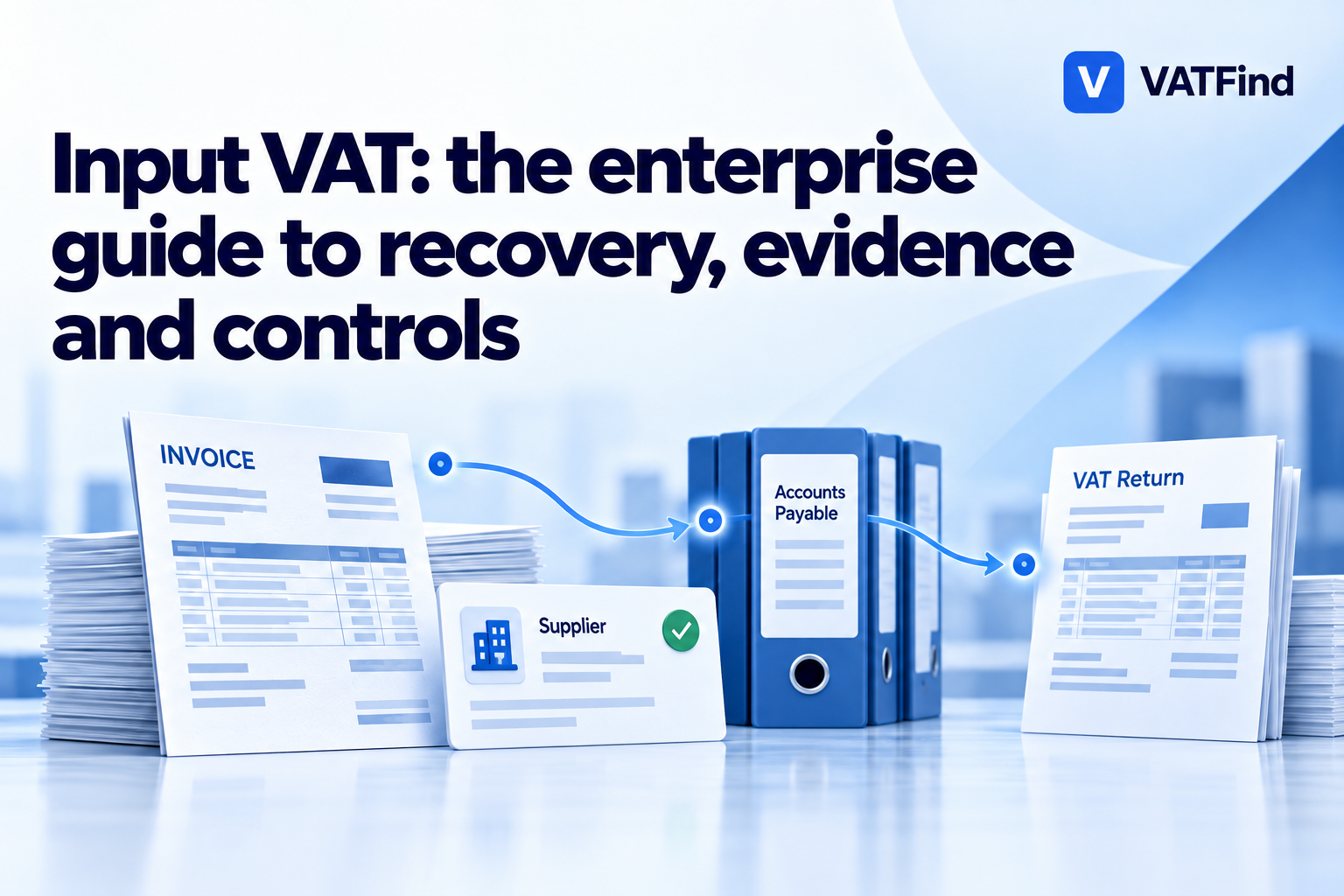
Input VAT recovery is not a simple total of VAT on purchase invoices. The claim must connect the correct recipient and supplier, a genuine taxable supply, business purpose, recoverable use, acceptable evidence and the correct period. Enterprise teams should make those links before posting, preserve exceptions and reconcile the decision through to box 4 of the VAT Return.
What input VAT means in the UK
Input VAT, also called input tax, is VAT incurred on purchases, imports and certain other transactions that a business may be entitled to deduct. Output VAT is the VAT a business accounts for on its taxable supplies. For a UK VAT Return, deductible input tax contributes to box 4; output tax and other amounts due contribute to box 1. The net position is not determined by copying every VAT-looking amount from the purchase ledger.
The legal starting point is narrower. The Value Added Tax Act 1994 defines input tax by reference to VAT on supplies to, acquisitions by and imports by a taxable person for the purpose of a business carried on or to be carried on by that person. Section 26 then makes the credit subject to regulations and attribution rules. HMRC's VAT Input Tax manual expresses the practical conditions: there must be a real supply, import or acquisition; it must be received by the claimant; it must serve the business; and the recovery must connect to supplies carrying a right to deduct.
This guide focuses on the ordinary UK invoice-accounting position checked on 26 September 2026. Schemes, sectors and transactions can change the mechanics. Cash accounting, the Flat Rate Scheme, partial exemption, imports, reverse charge transactions and capital items need their own rules. The operating lesson is consistent: classify the transaction first, then calculate the recoverable amount, rather than treating a VAT rate or a valid-looking invoice as automatic permission to reclaim.
The distinction matters most at scale. A single purchase can pass accounts-payable checks and still fail the tax test because the invoice names the wrong group entity, the spend has private or exempt use, VAT was charged incorrectly, the supplier document is incomplete or the claim falls in the wrong period. A reliable process records each decision and retains the evidence that made it reasonable at the time.
Input VAT and output VAT are different control populations
The two sides of the VAT account use different source records and review questions.
| Control point | Input VAT | Output VAT |
|---|---|---|
| Transaction side | Purchases, imports and relevant deemed transactions | Sales and other taxable outputs |
| Primary records | Supplier invoice, import evidence, receipt, contract and use | Sales invoice, contract, tax point and liability decision |
| Principal question | Is this VAT attributable and deductible by this claimant? | What VAT must this supplier account for? |
| Main return path | Deductible amount normally contributes to box 4 | VAT due normally contributes to box 1 |
| Common failure | Invoice total claimed without testing recipient, use or restriction | Wrong liability, rate, place or tax point |
The six gates for an input VAT recovery decision
A scalable recovery decision can be organised as six gates. The sequence prevents a team from spending time perfecting invoice fields for a transaction that fails an earlier substantive test. It also creates an exception code that says why an amount was held, instead of leaving a reviewer to infer the reason from a general ledger narrative.
First, establish that a supply, import or acquisition actually occurred and that UK VAT was properly in point. An amount labelled VAT is not automatically input tax. Second, establish the claimant: the supply must be made to the taxable person seeking the deduction. Who paid the invoice or who holds it does not by itself decide this question. For groups and shared-service arrangements, this is a legal-entity control, not merely a cost-centre choice.
Third, document business purpose and remove private or non-business use. Fourth, determine attribution: costs used to make taxable supplies will generally support recovery, while costs attributable to exempt supplies generally do not, subject to the partial-exemption rules and any applicable de minimis outcome. Fifth, apply specific blocks or restrictions, including rules affecting business entertainment and many motor-car purchases. Sixth, confirm the evidence and the period in which the deduction is claimed.
The gates are connected. A complete invoice cannot repair a claim by the wrong recipient. A valid supplier VAT number cannot establish that the transaction occurred. A business purpose does not remove a statutory block. Equally, an unavailable online check should not be turned into a conclusion that a supplier is fictitious. Treat identifiers, documents, payment and commercial evidence as separate signals, and route inconsistencies for review.
Input VAT recovery: six controlled gates
A claim should proceed only when each relevant gate is supported or an authorised exception is documented.
- 01Transaction
Confirm the supply, import or acquisition and whether VAT was properly charged.
- 02Claimant
Match the recipient and importing entity to the VAT registration making the claim.
- 03Business purpose
Identify intended and actual business use; separate private or non-business use.
- 04Attribution
Link the cost to taxable, exempt, specified or residual activity.
- 05Restrictions
Apply blocks, partial recovery, schemes and transaction-specific limits.
- 06Evidence and period
Hold acceptable records and claim in the correct return or correction route.
Input VAT vs output VAT: a controlled worked example
Illustrative example: a UK VAT-registered consultancy makes standard-rated net sales of £100,000 and correctly accounts for £20,000 of output VAT. It receives domestic purchase invoices with £15,000 of VAT. After reviewing the recipient, business purpose, taxable use and evidence, £12,000 is recoverable and £3,000 is blocked or non-deductible. Ignoring all other transactions and adjustments, the return has a net £8,000 payable position: £20,000 output VAT less £12,000 deductible input VAT.
The £15,000 purchase-ledger amount is not the box 4 figure. The £12,000 decision is. That difference is where weak workflows fail: they map the gross VAT field directly to a recoverable tax code, then ask tax to remove exceptions at period end. A stronger workflow records gross VAT, recoverable VAT and non-recoverable VAT separately, with a reason code and a link to supporting evidence.
If qualifying input VAT exceeds the output VAT due, the return can produce a repayment position, subject to the full return and HMRC processes. Do not force the input-tax claim down merely to avoid a repayment. Equally, do not assume that a repayment validates the underlying deductions. The control objective is an accurate return supported by traceable decisions, not a preferred cash result.
The example uses the UK standard rate only to show the arithmetic. Actual portfolios may include zero-rated, reduced-rated, exempt, outside-the-scope, reverse-charge and import transactions. Zero-rated supplies are taxable supplies and can support recovery; exempt supplies generally do not in the same way. Rate determination and deductibility are separate questions.
Supplier and legal-entity identity come before the tax code
Accounts payable should establish who supplied what to which group entity before deciding recovery. HMRC's manual states that only the person to whom the supply is made, for use in that person's taxable business, can make a valid input-tax claim. Payment by a shared service centre, an employee or an agent does not automatically move the supply to that payer. The invoice, contract, purchase order, delivery evidence and actual commercial relationship should tell a consistent story.
Supplier onboarding should preserve the legal name, trading name where relevant, company identifiers, VAT registration number, address, effective dates and the source of each field. A VAT-number check is one signal. If a result is invalid, unavailable or does not return a matching name, do not automatically infer that the company is fictitious. Check formatting and country assumptions, retry genuine service unavailability, compare authoritative company records, request corrected evidence and decide whether the invoice should be held.
The same discipline applies inside a VAT group. A purchase order raised by one company, an invoice addressed to another and a posting made to the representative member need a deliberate treatment. Do not solve this by replacing the invoice addressee in master data after the event. Record which entity contracted for and received the supply, which registration reports it, and why the accounting route is appropriate.
Create a dated supplier snapshot for material or higher-risk claims. Preserve the identifier supplied, the result observed, the matching decision and the reviewer. That snapshot is not proof of every element of recovery, but it helps demonstrate what the business checked. Reverification triggers can include a bank-account change, legal-name change, jurisdiction change, invoice-address conflict or repeated correction request.
VAT NUMBER RESEARCH
Check the company behind a VAT number
Use VATFind to research company and tax-identifier records, then keep the result in the wider evidence process.
Evidence must support the transaction, not just resemble an invoice
HMRC's VIT31000 guidance says a deduction must be supported by appropriate documentary evidence and lists a tax invoice meeting the VAT Regulations as the normal route. Less-detailed invoices can apply where the tax-inclusive value is £250 or less. Self-billing has its own conditions. Import VAT requires the appropriate import evidence. The evidence type must match the transaction rather than being selected for administrative convenience.
Test invoice fields structurally, then test them commercially. Structural checks include the supplier and customer details, unique number, tax point, description, values, VAT rate and VAT amount required for the document type. Commercial checks link the invoice to the purchase order, receipt, contract, payment and business use. A document can be perfectly formatted and still relate to the wrong entity, a duplicate, a non-supply or VAT that was not properly due.
Where the normal document is missing, do not convert alternative evidence into a routine bypass. HMRC's VIT31200 guidance describes discretion under regulation 29 and says alternative evidence is considered in exceptional circumstances. Relevant materials can include proof of the taxable supply, supplier status, payment, receipt and use. The authority makes the discretionary decision; an internal reviewer cannot guarantee that a claim will be accepted merely because several documents exist.
Design the exception queue accordingly. Missing mandatory fields should normally route back to the supplier for a corrected invoice. A duplicate should be blocked from payment and recovery. An amount of VAT that appears too high or low should be corrected with the supplier rather than overwritten locally; HMRC's error guidance directs recipients back to suppliers for replacement invoices. Preserve both the original and corrected record so the audit trail explains the change.
Evidence stack for a defensible claim
No single signal should be stretched beyond the question it can answer.
| Evidence layer | What it supports | What it does not prove alone |
|---|---|---|
| VAT invoice | VAT charged, parties, description, tax point and values | That the claimant received and used the supply for recoverable activity |
| Supplier identity | The legal entity and tax identifier associated with the supplier | That every invoice or VAT treatment is correct |
| PO, contract and receipt | Commercial purpose, authorisation and receipt of goods or services | That VAT was properly charged or deductible |
| Payment record | Settlement path and amount | Who received the supply or whether the tax is recoverable |
| Use and attribution record | Business purpose and connection to outputs | That the supplier document meets evidence rules |
VAT recovery requires attribution, not a blanket percentage
A partly exempt business makes both taxable and exempt supplies and incurs input tax connected with those activities. The first step is attribution. Input tax used exclusively for taxable supplies is normally recoverable. Input tax used exclusively for exempt supplies is normally not. Residual input tax that supports both populations is apportioned under the applicable partial-exemption method. Blocked tax is removed before the calculation.
HMRC's standard-method example in VAT Notice 706 starts with £12,500 directly attributable to taxable supplies, £7,500 directly attributable to exempt supplies, £500 of blocked business-entertainment tax and £15,000 of residual input tax. With taxable supplies of £135,000 and exempt supplies of £55,000, and after excluding the capital-item value specified in the example, the recoverable residual percentage is rounded up to 68%. That produces £10,200 of recoverable residual input tax.
The example illustrates process, not a default recovery rate. An enterprise must use its approved or applicable method, perform required annual adjustments and consider the standard method override where relevant. A global percentage stored against every supplier can be especially misleading: the same supplier may provide directly taxable, directly exempt and residual costs on different invoices.
Store the attribution basis at transaction or cost-category level where practicable. Keep the gross input tax, direct attribution, residual pool, applied percentage, recovered amount and period of any adjustment separately. This allows finance to reconcile the ledger while tax can reproduce the method. It also prevents a change in recovery percentage from rewriting the historical evidence that existed when an invoice was posted.
Blocked and restricted VAT needs explicit coding
Some VAT can meet the broad business-purpose test but still be blocked or restricted. HMRC's business-entertainment guidance generally blocks input tax on entertaining non-employees, while employee entertainment can be treated differently subject to the facts. The motoring rules generally block VAT on buying a car unless an exception applies, and leasing or fuel can produce separate recovery questions. Partial exemption does not turn blocked tax into residual recoverable tax.
An enterprise chart of accounts should therefore distinguish no VAT, VAT not properly charged, input tax that is blocked, input tax attributable to exempt activity, mixed-use apportionment and VAT deferred pending evidence. Posting all these outcomes to one non-recoverable account destroys information needed for remediation. A missing invoice might be recoverable later; blocked entertainment is a different outcome; incorrectly charged VAT should usually be corrected by the supplier.
Configuration should also prevent false precision. A tax code called 50% recoverable may be correct for a particular category and fact pattern but wrong elsewhere. HMRC's 2026 Guidelines for Compliance recommend unique tax codes, links to the correct general-ledger account and current configurations covering the organisation's supply chains. Effective-dated rules and documented ownership are more reliable than a spreadsheet of codes with no approval history.
Review recurring non-recoverable balances by cause. A rising missing-evidence balance may signal an accounts-payable or supplier problem. A rise in exempt attribution may reflect a business-model change. Repeated VAT-not-properly-due items may indicate that procurement instructions are wrong. The ledger should be able to reveal those patterns without exposing customer-level or identifiable validation data in management reporting.
Timing, pre-registration claims and later adjustments
The normal invoice-accounting claim belongs in the period when the VAT becomes chargeable and the claimant holds the required evidence. If the evidence arrives later, HMRC's manual says the claim is made on the return for the first prescribed period in which the document is held. Do not backdate the ledger silently. Record the original tax point, document-received date, posting period and claim period so the reconciliation can explain the difference.
Pre-registration input tax is not a general look-back across all expenditure. Regulation 111 and HMRC's VIT32000 guidance permit claims in specified circumstances, with different considerations for goods and services, continued ownership or use, business purpose, prior exempt or non-business use and evidence. Put proposed pre-registration claims in a separate reviewed population rather than mixing them into the first return through standard AP coding.
Later events can also change the position. Credit notes, changes in use, capital-goods adjustments, partial-exemption annual adjustments, unpaid consideration rules and error corrections have their own timing. HMRC's VAT Notice 700/45 distinguishes normal accounting adjustments from errors. Preserve that distinction: an approved annual partial-exemption adjustment should not be described or routed as if an invoice was posted incorrectly.
When the VAT shown on a supplier invoice is wrong, ask the supplier for a replacement document. When the business's own recovery logic was wrong, assess the correction route and time limit against current HMRC guidance. Maintain an error record showing how it arose, the affected period, whether it concerns input or output tax, the calculation and the related evidence. Tax should approve material correction decisions; software should not auto-net unrelated errors into an unexplained journal.
Build the control across procurement, AP, tax and reporting
Input VAT controls fail when ownership begins only at return preparation. Procurement defines the buying entity and contract. Supplier onboarding establishes identity and tax-master data. Accounts payable validates documents, receipt and coding. Business owners confirm purpose. Tax sets recoverability logic and decides exceptions. Financial control reconciles the ledger, adjustments and return. Each handoff needs a defined record and a responsible owner.
HMRC's 2026 Guidelines for Compliance frame VAT control across systems and processes, including organisation structures, tax codes, procure-to-pay, record-to-report and VAT reporting. The guidelines are recommendations rather than a single mandatory system design, but they provide a useful operating benchmark: authorised changes, current configuration, staff capability, correct invoice processing and reconciliations between VAT reports and general-ledger control accounts.
Create an exception taxonomy that maps to action. Examples include wrong legal entity, supplier identifier conflict, invalid invoice format, potential duplicate, VAT not properly due, missing business purpose, exempt attribution, blocked category, evidence pending and period mismatch. Assign a service level and escalation path by value and risk. Do not merge an authority-service outage with an invalid identifier result, and never label either as proof that a company is fictitious.
At close, reconcile three views: gross purchase-ledger VAT, recoverable input tax by return box and non-recoverable or deferred VAT by reason. Review manual adjustments separately and connect each to an owner and evidence pack. A balance that can be explained only by recreating a spreadsheet from email attachments is not a controlled process, even if the final return total happens to be correct.
One claim, four accountable workstreams
Recovery quality depends on upstream identity and transaction controls as well as the return review.
- Contracting entity
- Supplier identity
- VAT identifier evidence
- Change triggers
- Invoice fields
- Receipt and duplicate checks
- Gross/recoverable split
- Exception routing
- Business purpose
- Attribution and blocks
- Method and period
- Correction route
- Ledger reconciliation
- Adjustment approval
- Box 4 traceability
- Evidence retention
How input VAT implementation fails
The first common failure is to equate VAT shown with VAT recoverable. That bypasses recipient, business-purpose, attribution and restriction tests. The second is to perform those tests only on a sample at quarter end. High-volume systems then post thousands of exceptions to a fully recoverable code and rely on tax to find them after payment. Put deterministic checks at invoice entry and reserve judgement-heavy cases for review.
The third failure is a supplier master without history. A current VAT number or legal name overwrites the value that appeared on an older invoice, leaving no evidence of what was checked at the transaction date. Keep effective dates and snapshots. The fourth is duplicate recovery: a pro-forma, final invoice, credit note and replacement invoice are processed as independent documents. Match related document references and block a second claim until the chain is resolved.
The fifth failure is an ungoverned recovery percentage. A default rate is copied across entities, cost centres and years even though the attribution method or business mix changed. The sixth is silently editing evidence. A user replaces an invoice attachment or tax code without preserving the original, approval or reason. Use versioned records and event logs so reviewers can reproduce the route from source document to return.
The seventh is outsourcing responsibility without defining control evidence. A provider may extract invoice fields or check identifiers, but the business still needs to know what was checked, which result was returned, how exceptions were handled and how the final claim reconciles. Contract for exportable evidence, correction paths and access continuity. Do not accept an opaque confidence score as a legal conclusion about deductibility.
A practical input VAT implementation checklist
Start with a representative transaction inventory, not a software demonstration. Include domestic goods and services, imports, reverse-charge purchases, employee expenses, motor costs, entertainment, capital items, mixed-use costs, exempt activity, credit notes, self-billing and pre-registration items where relevant. Map each population to the claimant entity, required evidence, recovery decision, tax code, ledger account, return box and exception owner.
Then test failure cases. Use synthetic records where necessary and label them as such: wrong customer entity, supplier-name mismatch, unavailable validation service, duplicate invoice, altered bank details, missing VAT amount, VAT charged at the wrong rate, residual partial-exemption cost and late replacement invoice. Confirm that the workflow pauses the claim without declaring the supplier fictitious and that an authorised reviewer can release, restrict or reject the amount with a retained reason.
Finally, operate measurable controls. Monitor gross VAT held for evidence, aged exceptions, repeat supplier corrections, duplicate candidates, manual tax-code overrides, recovery changes after posting and differences between the input-tax ledger and box 4. Set thresholds after observing the portfolio rather than inventing an unsupported target. Value-weighted measures are usually more useful than a simple count of invoices.
- Confirm the claimant entity and VAT registration before coding the invoice.
- Separate gross VAT, recoverable VAT, restricted VAT and deferred VAT in the data model.
- Record business purpose and attribution for costs that are not inherently clear.
- Require the correct document type and preserve corrected-document chains.
- Apply blocked and partial-recovery rules through approved, effective-dated logic.
- Route invalid, unavailable and mismatch results as distinct outcomes.
- Reconcile the purchase ledger, VAT control accounts, manual adjustments and box 4.
- Retain evidence and approval history for the applicable record-retention period.
Questions to ask an input VAT technology or data provider
Ask the provider to show the data lineage for a recovered amount. Can it preserve the original invoice, extracted fields, supplier identity, tax-code version, restriction reason, reviewer and posting period? Can a reviewer distinguish gross VAT from deductible VAT? Can a corrected invoice be linked to the original without creating a second claim? A clean dashboard is useful only when the underlying decision can be exported and explained.
Ask how identity outcomes are represented. Does an unavailable authority service remain unavailable, or is it collapsed into invalid? Is a name mismatch shown as a comparison result rather than an accusation? Can the workflow retain the identifier supplied by the vendor and the business record selected by the reviewer? Can rules be scoped by legal entity, jurisdiction and effective date? These questions matter more than the number of integrations shown in a sales presentation.
Ask where tax judgement begins and the product claim ends. Company-data matching can support onboarding and research; it does not prove that a supply occurred, that VAT was properly due or that a purchase is deductible. Invoice extraction can identify fields; it does not decide business purpose. A recovery engine can apply configured rules; tax owners still need governance for legal interpretations, exceptions and changes.
For outsourcing, ask about access continuity, evidence delivery, correction ownership and exit. Require a complete record of open exceptions and historical decisions in a usable format. Test a provider with the difficult cases in your portfolio, not only a perfect domestic invoice. The objective is a controlled operating process that remains understandable when personnel, systems or suppliers change.
ENTERPRISE DATA
Discuss supplier and company-data requirements
Review VATFind delivery options for onboarding, AP and tax-master workflows at enterprise scale.
PRACTICAL ANSWERS
Frequently asked questions
What is input VAT?
Input VAT, or input tax, is VAT incurred on eligible business purchases, imports and certain other transactions. A UK VAT-registered business may deduct the amount that meets the legal recovery conditions; VAT shown on every purchase document is not automatically recoverable.
What is the difference between input and output VAT?
Input VAT is incurred on purchases and can be deducted when the recovery rules are met. Output VAT is VAT a business accounts for on taxable supplies. The net return position reflects both populations plus any other required entries and adjustments.
Which VAT Return box contains input VAT?
Deductible input tax normally contributes to box 4 of the UK VAT Return. Transaction-specific rules, schemes and adjustments can affect the mapping, so reconcile the amount to the evidence and applicable guidance.
Can you reclaim VAT without a valid VAT invoice?
A compliant VAT invoice or other prescribed document is the normal evidence. HMRC has discretion to consider alternative evidence in exceptional circumstances, but that is not a routine substitute and acceptance cannot be assumed.
Does a valid supplier VAT number prove input VAT is recoverable?
No. It supports one identity check. Recovery also depends on the claimant, the actual supply, business purpose, attribution, restrictions, evidence and timing. An invalid, unavailable or mismatched check should be investigated without inferring that the supplier is fictitious.
Can VAT on exempt activities be recovered?
Input tax directly attributable to exempt supplies is generally not recoverable, subject to the detailed partial-exemption rules and any applicable de minimis outcome. Residual input tax is apportioned using the applicable method.
Is VAT on business entertainment recoverable?
UK rules generally block input tax on entertaining non-employees. Employee entertainment and limited overseas-customer situations can require different analysis. Apply the current rules to the facts rather than using a single hospitality code.
Can pre-registration input VAT be claimed?
Potentially, under regulation 111 and HMRC guidance, if the relevant conditions for goods or services, timing, ownership or use, business purpose and evidence are met. Review proposed claims separately rather than treating all historic spend as deductible.
What should happen when VAT on a supplier invoice is wrong?
Ask the supplier for a corrected or replacement invoice. HMRC guidance says a recipient faced with VAT shown too high or too low should return to the supplier. Preserve the original and corrected document chain and assess any return correction separately.
How should an enterprise control input VAT recovery?
Connect supplier identity, recipient entity, invoice evidence, receipt, business purpose, attribution, restriction and period in one traceable workflow. Separate gross, recoverable, non-recoverable and deferred VAT, route exceptions by reason and reconcile the result to box 4.