Treat reverse charge VAT as a transaction-classification and evidence problem, not a special tax code. The control must identify the exact regime, supplier and customer status, place of supply, invoice wording, VAT Return boxes and recovery restriction before posting. An unavailable VAT-number service, a name mismatch or a missing end-user declaration is an exception to investigate—not proof that a company is fictitious.
What is reverse charge VAT?
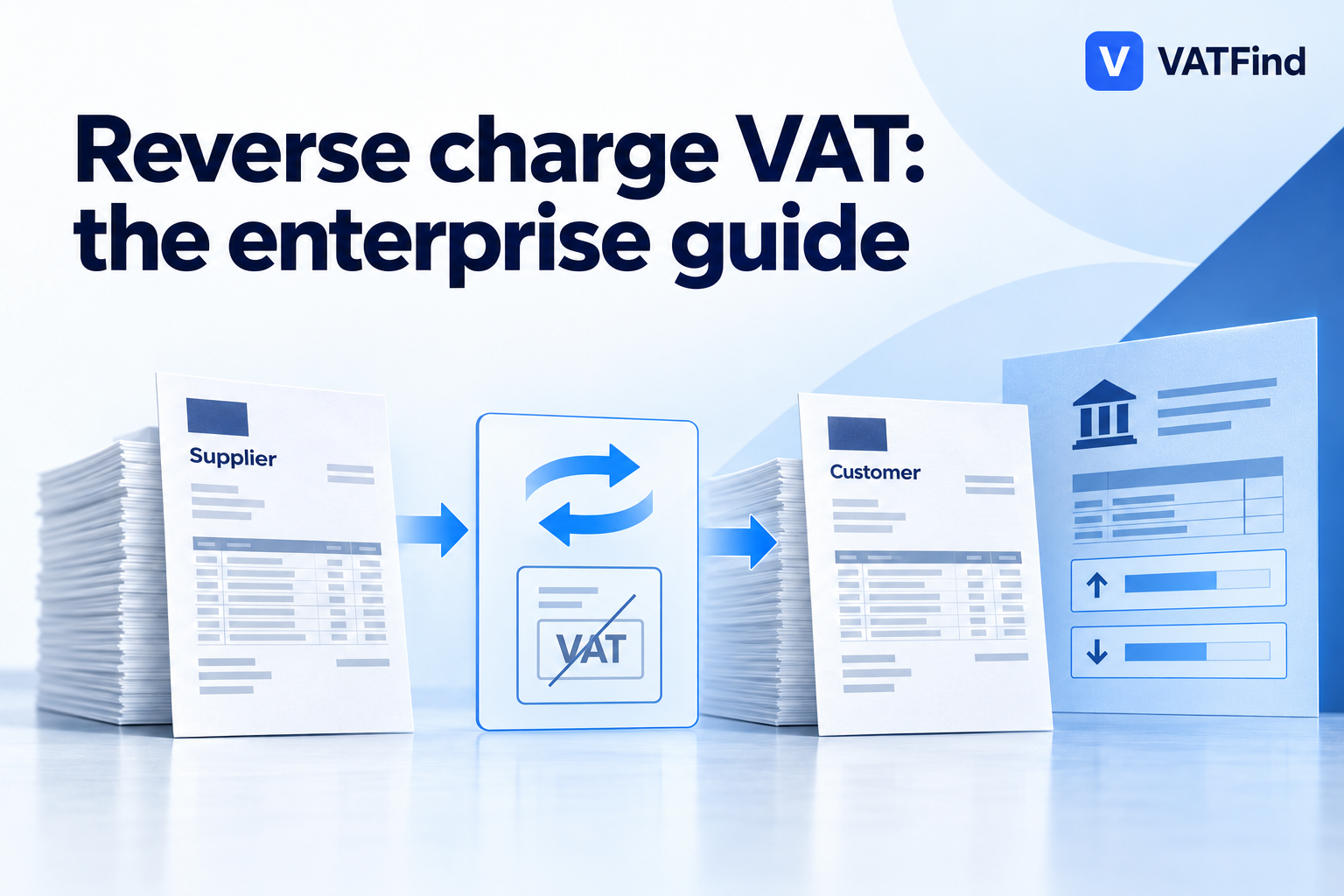
Reverse charge VAT moves the responsibility for accounting for VAT from the supplier to the customer. The supplier usually issues an invoice without collecting the VAT that would otherwise be charged. The customer calculates the tax, reports it as output tax and, where entitled, claims the corresponding input tax. The entries can offset for a fully taxable business, but the mechanism is not automatically cash-neutral where input tax is restricted.
That short definition is correct but incomplete. In the UK, reverse charge is not one universal rule. It can arise for services bought from abroad, specified domestic goods and services, and qualifying construction services. The conditions, invoice wording and VAT Return entries are not identical. A tax code called 'reverse charge' without a regime field can therefore produce a technically balanced return that is still wrong.
The practical purpose of several domestic reverse charges is to reduce the risk that a supplier collects VAT and does not pay it to HMRC while the customer still claims input tax. HMRC describes the domestic procedure in VAT Notice 735 as an anti-fraud measure. That does not mean every exception, mismatch or incorrect invoice indicates fraud. Most operational failures begin with ordinary classification, master-data or workflow errors.
For enterprise teams, the decisive question is not simply whether an invoice says 'reverse charge'. It is whether the underlying transaction meets the relevant legal conditions. Invoice wording is evidence of the supplier's treatment; it does not replace the customer's own decision. Accounts payable should route the invoice using structured facts such as supplier establishment, customer VAT status, supply category, place of supply, CIS context, end-user status, value threshold and tax point.
Who is affected—and why ownership crosses teams
The VAT reverse charge affects more than tax specialists. Accounts payable needs to recognise invoices where VAT should not have been charged and calculate the correct entries. Accounts receivable needs compliant wording and must avoid collecting tax where the customer should account for it. Procurement needs accurate supplier and contract data. Master-data teams need reliable legal-entity, establishment and VAT-registration fields. Tax owns the decision rules, recovery restrictions and reporting position.
Construction businesses face an additional dependency on the Construction Industry Scheme. The VAT domestic reverse charge for qualifying building and construction services has applied since 1 March 2021. Broadly, the supply must be within the relevant construction scope, subject to VAT at the standard or reduced rate, made between appropriately registered parties, and supplied to a customer that is not an end user or qualifying intermediary supplier for that transaction. A CIS deduction decision and a VAT decision are related inputs, not the same result.
Businesses buying general B2B services from suppliers outside the UK can also be affected. Under the usual place-of-supply rule, the supply is treated as made where the business customer belongs, and the UK customer accounts for VAT through the reverse charge. Exceptions exist, so country alone is not a safe tax rule. The service type, customer status, establishment that most directly uses the service and any special place-of-supply rule still matter.
Domestic specified supplies create a third population. HMRC VAT Notice 735 covers categories including mobile phones, computer chips, wholesale gas and electricity, emission allowances, wholesale telecommunications, renewable energy certificates and construction services. Mobile phones and computer chips have an invoice-based £5,000 VAT-exclusive threshold; the same threshold should not be copied to every category.
Three UK reverse-charge routes that should not share one blind rule
The regimes use different triggers even though the customer accounts for VAT.
| Control field | Imported B2B services | Domestic construction | Other specified domestic supplies |
|---|---|---|---|
| Supplier context | Usually outside the UK | UK construction supply chain | UK taxable persons |
| Core trigger | UK place of supply under the applicable service rule | Qualifying service, VAT/CIS status and not an end-user case | Goods or services listed in VAT Notice 735 |
| Value threshold | No general £5,000 rule | No general £5,000 rule | £5,000 invoice threshold for phones/chips only |
| Customer evidence | Business status and establishment using the service | VAT/CIS status plus end-user or intermediary status | VAT status, business purpose and category-specific facts |
| Return pattern | Customer commonly uses boxes 1, 4, 6 and 7 | Supplier box 6; customer boxes 1, 4 and 7 | Supplier box 6; customer boxes 1, 4 and 7 |
| Primary HMRC source | VAT Notice 741A | Construction guide and technical guide | VAT Notice 735 |
The UK reverse-charge timeline is a set of separate scope decisions
The current UK regime was built in stages. Treating the latest category as a replacement for earlier measures is a common design mistake. Mobile phones and computer chips entered the domestic reverse charge on 1 June 2007. Emission allowances followed on 1 November 2010; wholesale gas and electricity on 1 July 2014; wholesale telecommunications on 1 February 2016; renewable energy certificates on 14 June 2019; and construction services on 1 March 2021.
Administrative changes do not necessarily remove the underlying tax treatment. From 1 July 2022, businesses no longer had to submit Reverse Charge Sales Lists for mobile phones and computer chips, but HMRC states that the reverse charge continued to apply. A system migration that equates 'report discontinued' with 'tax rule discontinued' can silently reintroduce VAT on transactions that remain in scope.
The most recent material update in the research window was 13 March 2026. HMRC added section 3.5.4 to VAT Notice 735 to explain why the domestic reverse charge does not apply to electricity supplied at an electric-vehicle charging point. It is a clarification within one category, not a new reverse-charge regime. Rule libraries should preserve that distinction by storing authority, effective date, scope and exception separately.
UK domestic reverse-charge milestones, 2007–2026
Effective and administrative dates in HMRC VAT Notice 735.
- 011 Jun 2007
Mobile phones and computer chips entered the domestic reverse charge.
- 021 Nov 2010
Emission allowances were added; the category was amended from 1 May 2021.
- 031 Jul 2014
Wholesale gas and wholesale electricity were added.
- 041 Feb 2016
Wholesale telecommunications entered the regime.
- 0514 Jun 2019
Renewable energy certificates were added.
- 061 Mar 2021
Qualifying building and construction services began using the reverse charge.
- 071 Jul 2022
Reverse Charge Sales List reporting ended for phones and chips; the tax treatment remained.
- 0813 Mar 2026
HMRC clarified that electricity supplied at an EV charging point is outside the domestic reverse charge.
Domestic reverse charge VAT for construction: decide per supply
Construction is where a simple supplier-level flag causes the most damage. The same contractor can receive reverse-charge treatment on one project and ordinary VAT on another. The customer may be onward-supplying construction services on a commercial development but acting as an end user for work on its own property. Product, project and contractual purpose therefore belong in the decision, not only in the supplier record.
Start with the service. HMRC's technical guidance links the reverse charge to construction operations within the relevant CIS scope, while listing exclusions and special cases. Then establish VAT liability: zero-rated supplies do not become reverse-charge supplies merely because they are construction work. Confirm that both parties have the required status, determine whether the customer is an end user or intermediary supplier, and obtain any written notification needed to support ordinary VAT treatment.
Mixed supplies require care. HMRC explains that when a supply contains both reverse-charge and non-reverse-charge construction elements, the treatment may extend to the whole supply in specified circumstances. Materials supplied with construction services can follow the service treatment as part of a single supply. Splitting lines solely to force a preferred outcome is not a control; the contractual and economic supply must be understood.
A durable workflow records the decision at project or purchase-order level and rechecks it when facts change. End-user status can differ by project. VAT or CIS registration can change. A credit note may refer to an earlier period. The invoice processor should see the effective-dated decision, its source evidence and the person responsible for exceptions rather than re-answering the legal test from free-text notes.
A six-gate construction decision before invoice posting
Each gate needs a recorded fact, not an assumed supplier default.
- 01Classify the supply
Identify the actual construction operation and whether the relevant CIS scope applies.
- 02Confirm VAT liability
Determine whether the underlying supply is standard-rated, reduced-rated, zero-rated or exempt.
- 03Verify supplier status
Link the invoice to the legal supplier and effective VAT registration evidence.
- 04Verify customer status
Confirm the purchasing entity's VAT and CIS position for the transaction.
- 05Resolve end-user status
Use project-specific facts and retain a written declaration where ordinary VAT treatment depends on it.
- 06Validate and post
Check wording, tax point, tax code, return boxes, recovery restriction and audit evidence.
Invoice controls: wording, amount and tax point must agree
For domestic specified supplies, HMRC states that a reverse-charge invoice must contain the normal VAT-invoice information and a reference that makes clear the customer must account for VAT. Accepted examples include 'reverse charge: VAT Act 1994 Section 55A applies' and 'reverse charge: Customer to pay the VAT to HMRC'. The tax to be accounted for should be identifiable, but it is not included as VAT charged in the invoice total.
That creates several machine-validation tests. The invoice should carry the supplier and customer identities expected for the transaction, the relevant VAT numbers, an invoice and tax date, a clear description, net value, applicable rate or tax category, reverse-charge wording and an amount payable that does not collect the customer's self-assessed tax. If a structured invoice expresses the rule as a code, both parties must be able to demonstrate the meaning to HMRC.
The customer should not accept an invoice merely because its arithmetic balances. If ordinary VAT is charged where a reverse charge should apply, paying and reclaiming that amount can create exposure. HMRC VAT Notice 735 says an incorrect treatment can lead to assessments, corrections, penalties and the need for the supplier to credit the customer. The fastest process is therefore not straight-through posting at all costs; it is early, explainable exception routing.
Credit notes and price changes need to reference the original treatment. A document that reverses only the net value while leaving the self-assessed tax untouched can produce mismatched periods. Store the original invoice ID, original regime, corrected value, revised tax point and both parties' required VAT Return adjustments.
VAT reverse charge example: £10,000 at 20%
Consider an illustrative £10,000 supply that would be standard-rated at 20% if ordinary UK VAT applied. Under ordinary treatment, the supplier invoices £12,000, collects £2,000 of VAT and accounts for that output tax. Under a domestic reverse charge, the supplier invoices and collects £10,000. The customer calculates £2,000 as output tax and, assuming full recovery, claims £2,000 as input tax on the same return.
The example shows why 'no VAT on the invoice' does not mean 'outside VAT'. The customer still has a tax calculation and reporting obligation. It also shows why a partially exempt or non-business customer can experience a real cost: the £2,000 output entry may not be matched by a full £2,000 input deduction. Recovery must be calculated under the customer's actual rules.
The posting should preserve both the tax amount and the fact that it was self-assessed. A zero-rate code is not equivalent. Zero-rating says the supply carries a 0% liability; reverse charge says the customer accounts for tax that would otherwise be due. Conflating the two can corrupt VAT Return mapping, tax reporting and later evidence.
Illustrative invoice economics: ordinary VAT versus reverse charge
A £10,000 net supply at an assumed 20% rate; bars start at zero.
VAT Return mapping: supplier and customer entries are different
For a supplier making a domestic reverse-charge supply under VAT Notice 735, the VAT-exclusive sales value goes in box 6 and there is no output tax in box 1. The customer includes the self-assessed output tax in box 1, claims deductible input tax in box 4 and includes the VAT-exclusive purchase in box 7. The customer does not put that domestic purchase in box 6.
Services bought from abroad commonly follow a different pattern because the UK customer effectively accounts for both sides of a supply treated as made in the UK. HMRC's place-of-supply and return guidance should be used for the actual transaction; a common fully taxable B2B-service pattern uses boxes 1 and 4 for tax and boxes 6 and 7 for value. Do not copy the domestic construction mapping into imported-service logic.
Tax engines should output a regime identifier and explicit box mapping, not just a tax amount. Reconciliation should compare invoice-level reverse-charge tax to the VAT account and return boxes by regime. A net-zero total is not proof of accuracy: equal and opposite errors can cancel in the payable amount while leaving boxes, period attribution or deductible tax wrong.
VAT Return box treatment by party and regime
A control matrix for common UK patterns, subject to the underlying facts.
| Return box | Domestic supplier | Domestic customer | UK customer: general B2B service from abroad |
|---|---|---|---|
| Box 1 — output tax | No reverse-charge output tax | Self-assessed tax | Self-assessed tax |
| Box 4 — input tax | Not applicable to the sale | Deductible amount, subject to recovery rules | Deductible amount, subject to recovery rules |
| Box 6 — sales value | Net sale value | Do not include domestic purchase | Include the relevant value under the imported-service rule |
| Box 7 — purchase value | Not applicable to the sale | Net purchase value | Net purchase value |
| Key reconciliation | Invoice net value to box 6 | Self-assessed tax and recovery by tax point | Regime, establishment, tax point and both value boxes |
Supplier and customer evidence: verify the claim without overclaiming
Reverse-charge decisions often depend on VAT status and legal identity. HMRC's UK VAT-number service can check whether a UK VAT registration number is valid and return the name and address to which it is registered. A UK VAT-registered checker can also obtain evidence of when it performed the check by providing its own VAT number. The service cannot find a VAT number from a company name, so discovery and official validation are separate tasks.
Store the submitted identifier, normalised identifier, source service, response, registered name and address where supplied, timestamp, consultation evidence and the legal company record to which the result was matched. Keep company-registration status separate from VAT-registration status. A company can exist without a current VAT registration, and a VAT check does not answer every corporate-identity or counterparty-risk question.
Treat outcomes precisely. 'Valid' means the authority service returned the relevant positive result at that time; it does not prove every invoice fact. 'Invalid' means the service did not confirm the submitted number under its rules; it does not establish that the business is fictitious. 'Unavailable' means no usable authority response was obtained. A name or address mismatch can reflect a trading name, group structure, branch, historic data or input error and should enter review.
Procurement and tax should agree what evidence is required before the reverse charge is applied. For construction, that can include VAT and CIS status, the contracting entity, project role and written end-user notification. For imported services, it can include the supplier establishment, contracting entity, service type and customer establishment using the service. The evidence set should be proportionate, dated and repeatable.
VAT NUMBER EVIDENCE
Resolve the company behind an invoice VAT number
Use VATFind to find and compare company and VAT-number records, then retain the relevant official authority response as separate dated evidence for your tax decision.
How implementation fails in real finance systems
The first failure is a global supplier flag. It assumes every invoice from a contractor, overseas supplier or energy trader receives the same treatment. In reality, reverse charge is transaction-specific. Project role, service type, customer establishment, invoice value, onward supply and end-user status can change the result.
The second failure is using a zero-rate code. This suppresses VAT but may not create the customer's box 1 output entry, box 4 recovery entry or correct value-box mapping. The payable amount looks reasonable, so the error survives until reconciliation or audit. Tax codes should encode the regime and return logic, not just the printed rate.
The third failure is trusting invoice wording as the decision. Suppliers can make mistakes, and accounts-payable OCR can misread a note. The system needs a rule outcome independent of the wording, then compares the two. A conflict should stop automatic posting and request correction or review.
The fourth failure is overwriting evidence. Rechecking a VAT number and replacing the old response destroys the audit trail for an earlier invoice. Evidence should be append-only with effective times and links to the decision that used it. The fifth failure is collapsing unavailable, invalid and mismatch states into one rejection. That produces false allegations, blocks legitimate suppliers and prevents teams from seeing whether the problem is data quality, service availability or substantive status.
The sixth failure is assuming a net-zero return effect means no risk. Partial exemption, non-business use, wrong periods and incorrect boxes can create tax and penalty exposure even where the total payable appears unchanged. HMRC's error-correction guidance says careless or deliberate errors can attract penalties, while reasonable care and timely correction matter.
- Supplier default replaces a transaction-level decision.
- Zero-rate code omits self-assessed output tax.
- Invoice text overrides contradictory contract or registration facts.
- VAT check is stored without source, timestamp or company match.
- Unavailable and mismatch outcomes are labelled invalid.
- Credit notes lose the original regime and tax point.
- Return reconciliation tests net VAT only, not individual boxes.
- Full input recovery is assumed for partially exempt or mixed-use entities.
A practical operating model for tax, finance, procurement and data teams
Tax should own the rule catalogue: regime, scope, exclusions, effective dates, required evidence, invoice treatment, return mapping and escalation. Finance systems should execute those rules and expose the decision. Procurement should collect contract-purpose and supplier-identity facts before the first invoice. Accounts payable should own document comparison and exception ageing. Master-data teams should maintain legal entities, registrations and establishment attributes with history.
The control point should sit before final posting but after sufficient transaction data is available. At purchase-order creation, the system can identify a likely reverse-charge route and request missing declarations. At invoice receipt, it can calculate the final treatment using the document, order, supplier record and effective-dated evidence. At posting, it should write the tax code, calculated amount, return mapping and decision reason as one auditable package.
Monitoring should focus on exceptions and changes, not only throughput. Useful measures include invoices blocked for missing status evidence, suppliers with name mismatches, reverse-charge invoices carrying VAT, ordinary invoices from suppliers expected to use reverse charge, end-user declarations older than the project facts, and differences between invoice-level tax and VAT Return boxes. Avoid publishing customer-level VAT validation data in dashboards or editorial material.
The business also needs a service-availability policy. If the official VAT-number service is unavailable, the workflow should record the attempt, preserve the submitted number, apply the approved hold or fallback policy and schedule a retry. It should not convert a technical outage into an 'invalid' status or a claim about the supplier's legitimacy.
Questions to ask software vendors and implementation partners
A product demonstration should use mixed scenarios rather than one perfect invoice. Ask the vendor to show a contractor that is an onward supplier on one project and an end user on another, an overseas service where a special place-of-supply rule applies, a mobile-phone invoice around the £5,000 threshold, a partially exempt customer and a credit note issued in a later period.
The objective is to see what the system knows, what it infers and what it leaves to the customer. A rule engine that returns only 'reverse charge: yes' is insufficient for audit and change management. It should identify the regime, effective rule, evidence used, failed conditions, tax point, calculated tax, recovery treatment and return boxes.
- Can the system distinguish imported services, domestic construction and other specified domestic supplies?
- Can reverse-charge treatment vary by project, purchase order or invoice for the same supplier?
- Which fields are effective-dated, and can prior decisions be reproduced after master data changes?
- How are invalid, unavailable and company-name mismatch outcomes represented?
- Can the invoice wording be compared with an independently calculated tax treatment?
- Does the product support partial-exemption restrictions and mixed business/non-business use?
- How are credit notes linked to the original regime and return period?
- Can users export the decision reason, evidence reference and VAT Return mapping for audit?
- What happens when an authority service or integration is unavailable?
- Which legal decisions remain the customer's responsibility?
ENTERPRISE DATA WORKFLOW
Design VAT and company matching for your supplier process
Talk to VATFind about entity resolution, supplier-master remediation and scalable VAT or EIN/company matching for procurement and finance operations.
Reverse charge VAT implementation checklist
Use the checklist as a control design review, then test it with real but appropriately protected transactions from every business unit. Sampling only clean head-office invoices will miss the project, branch, currency, credit-note and legacy-supplier cases that create most failures.
- Inventory every reverse-charge regime used by the group and its effective dates.
- Map each regime to legal entities, business units, supplier populations and transaction types.
- Separate legal company identity, VAT registration, CIS status, establishment and commercial approval fields.
- Define required evidence and refresh triggers for each material decision.
- Create explicit valid, invalid, unavailable, mismatch and pending-review states.
- Configure invoice wording, tax calculation and VAT Return boxes as linked but separate controls.
- Test full and restricted input-tax recovery, including partial-exemption cases.
- Test ordinary invoices that should be reverse charged and reverse-charge invoices that should carry VAT.
- Preserve original decisions when master data or authority responses change.
- Build credit-note and price-adjustment logic that refers to the original tax treatment.
- Reconcile invoice-level amounts to boxes 1, 4, 6 and 7 by regime and period.
- Assign owners and response times for every exception type.
- Document the official-service outage policy and retry process.
- Review rule changes, guidance updates and system releases through controlled change management.
The control objective is a reproducible decision
Reverse charge VAT is straightforward only after the right facts are known. The supplier, customer, service, place of supply, project role, VAT status, threshold, tax point, invoice wording and recovery position can all affect the result. Enterprise scale turns those facts into a data-governance problem.
The strongest design does not hide complexity behind one tax code. It records which reverse-charge regime applied, why it applied, what evidence was used, how the invoice should read, which party accounts for tax, where the values enter the VAT Return and who resolved any exception. That record lets finance process efficiently, tax defend the position and procurement correct upstream data.
This guide provides general information, not personalised tax or legal advice. Apply the current HMRC guidance and legislation to the actual transaction, and involve an appropriate adviser where the facts or treatment are uncertain.
PRACTICAL ANSWERS
Frequently asked questions
What is reverse charge VAT in simple terms?
It is a VAT mechanism in which the customer, rather than the supplier, accounts for the tax. The supplier normally invoices the net amount without collecting the reverse-charge VAT, and the customer records output tax plus any deductible input tax under the applicable rules.
When does reverse charge VAT apply in the UK?
It can apply to qualifying services bought from abroad, specified domestic goods and services, and qualifying building and construction services. Each regime has its own conditions, so supplier country or invoice wording alone is not enough.
Does the domestic reverse charge VAT apply to every construction invoice?
No. The service, VAT liability, supplier and customer status, CIS context, onward-supply position and end-user or intermediary-supplier status can all matter. The decision should be made for the transaction or project, not as a permanent supplier default.
What must a reverse-charge invoice show?
It must contain the normal required VAT-invoice information and make clear that the customer accounts for VAT. For domestic specified supplies, HMRC accepts wording such as 'reverse charge: VAT Act 1994 Section 55A applies'. The tax should not be collected as part of the invoice total.
Which VAT Return boxes are used for domestic reverse charge VAT?
For a common domestic case, the supplier reports the net sale in box 6 without reverse-charge output tax in box 1. The customer records self-assessed tax in box 1, deductible input tax in box 4 and the net purchase in box 7. Imported-service and Northern Ireland goods rules can differ.
Is reverse charge VAT the same as zero-rated VAT?
No. Zero-rating applies a 0% VAT liability. Reverse charge moves responsibility for accounting for VAT to the customer. Using a zero-rate code can omit required self-assessed tax and VAT Return entries.
Is reverse charge VAT always cash-neutral for the customer?
No. A fully taxable customer may claim input tax equal to the self-assessed output tax, but partial exemption, non-business use or other recovery restrictions can reduce the deduction and create a real cost.
What does an invalid UK VAT-number result mean?
It means the official service did not confirm the submitted number under its rules at that time. It does not prove that a company is fictitious. Check the input, country context, legal entity and supporting documents, and distinguish invalid from unavailable or mismatched outcomes.
What should a buyer do if a supplier charges VAT when reverse charge should apply?
Route the invoice for review and obtain the appropriate corrected document or credit note rather than assuming the VAT is recoverable. Preserve the original invoice, correspondence, decision and resulting return corrections.
How often should reverse-charge supplier evidence be refreshed?
Use a risk-based policy and refresh when a registration, entity, contract, project role or invoice treatment changes. Keep every response with its source and timestamp so an earlier decision can be reproduced instead of overwriting history.