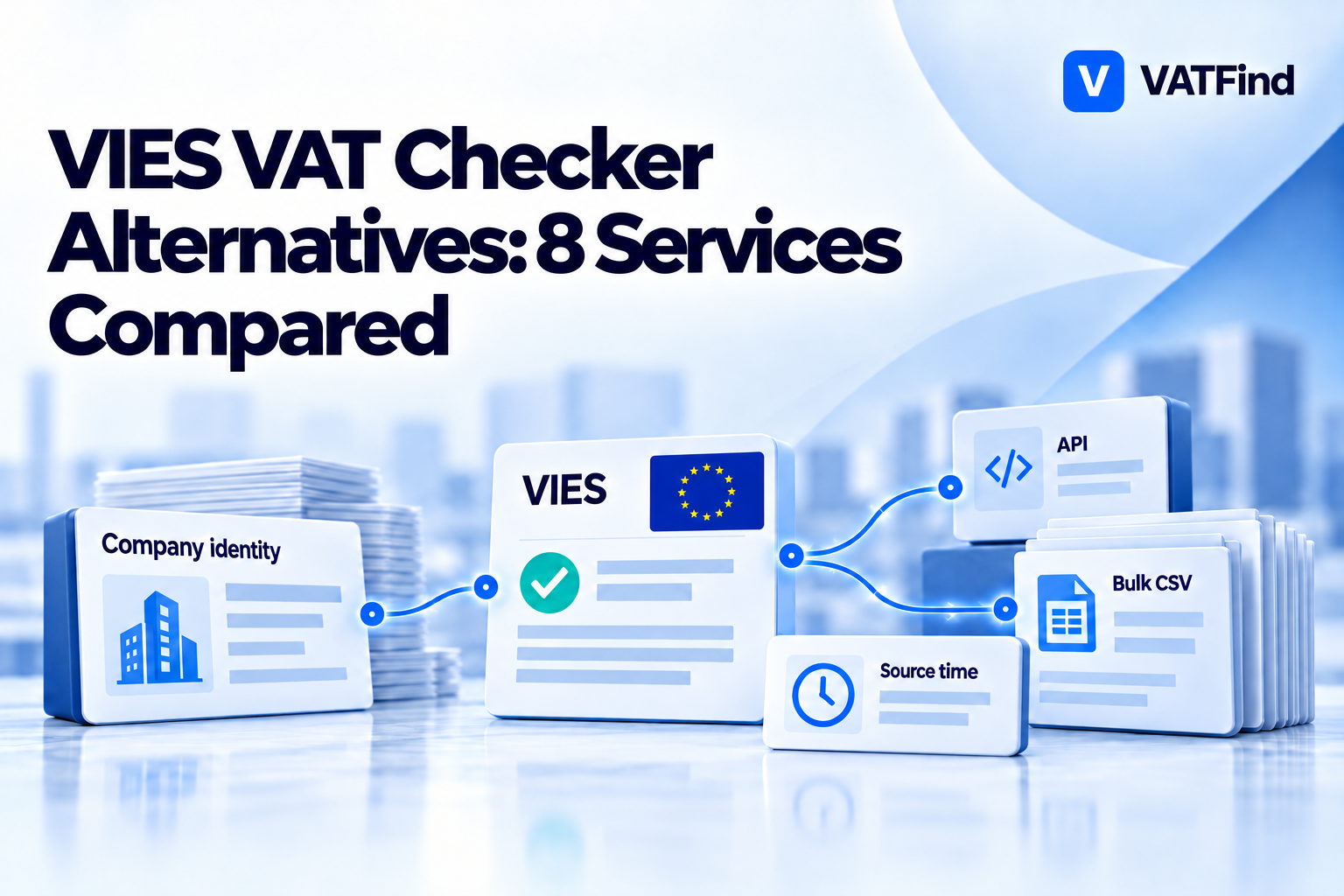
Start with the evidence you need. VIES answers an EU VAT-status question. VATFind adds the legal-company context behind an identifier. Specialist APIs and enterprise tax platforms serve different integration needs. A valid VAT number alone does not verify a supplier’s bank account.
Eight services at a glance
This VIES VAT checker alternatives guide covers eight services with different jobs. Some return live authority status, some add legal-company identity, and others embed validation in billing or ERP workflows. Choose the result your process needs before comparing subscriptions.
This is a VATFind-published comparison. The order is editorial, not an independent performance ranking. Prices and product scope were reviewed on 2 October 2026; unknown capabilities are not treated as absent.
Compare by the job to be done
Start with the workflow, then check the full pricing and limitations below.
| Provider | Best fit | Scope | Pricing basis | Key trade-off |
|---|---|---|---|---|
| VIES | Official status | EU + Northern Ireland | Free | Build your own retries and records |
| VATFind | Company identity | Global company records | From $99/month | Not live authority status by default |
| Global Database | Enterprise intelligence | Country-specific tax and registry data | Contact sales | Scope countries and fields |
| Fonoa | Global tax-ID batches | 120+ countries | Contact sales | Enterprise implementation |
| Vertex Validator | ERP and checkout | 70+ countries/regions | Contact sales | Govern cache freshness |
| Stripe Tax | Stripe billing | EU VAT, GB VAT, ABN validation | Tax-platform pricing | Asynchronous customer-ID flow |
| VATify.eu | European API and monitoring | 40+ national sources | €14/month + usage | National responses vary |
| vatlayer | EU developer API | EU validation and rates | From $9.99/month | Request-based allowance |
What does the result actually prove?
A format check, a live VAT-status response and a company-record match answer different questions. Keep them separate in your system, even when a provider presents them together. None verifies the beneficiary bank account or the authenticity of a payment instruction.
For supplier onboarding, compare the submitted legal name and address with the company record. For checkout, decide how to handle a delayed authority response. For a large cleanup, prioritise row-level evidence, exception handling and controlled ERP updates.
Four separate checks
Record each outcome independently; one green result must not stand in for the others.
- 01Format
Is the identifier syntactically plausible?
- 02Authority status
What did the official VAT service return, and when?
- 03Company identity
Does the legal entity match the submitted business?
- 04Internal approval
Have exceptions and payment controls been resolved?
RESULT SEMANTICS
Separate VAT lookup from live validation
Use the VATFind guide to map company-record evidence, authority status and transaction decisions before choosing an integration.
Official checks and company identity
These three services illustrate the main distinction: a VAT-registration answer versus the company context needed to interpret an identifier. For some workflows, the two types of evidence are complementary.
Official EU service
VIES
The European Commission’s VAT Information Exchange System queries national databases to check whether an EU or Northern Ireland VAT number is recognised for cross-border activity.
Strengths. Free official status checks, with a consultation reference where supported. Some national services return the registered name and address alongside the result.
Limitations. Identity fields differ by country. Your integration must handle national outages, retries and evidence storage. Invalid, unavailable and incomplete registration are different outcomes; none alone proves a fictitious company.
Pricing. Free public service, with no subscription or commercial service-level contract.
Best for. One-off EU checks or an internal validation workflow with its own logging and retry controls.
Company identity, API and bulk data
VATFind
VATFind connects VAT numbers, EINs and company names to legal-company records. It returns available identifiers, registered details, company status, source information and retrieval time.
Strengths. Shows the company behind the supplier or customer relationship, with traceable evidence from government-registry records. Country and field availability varies. Monthly plans without a long-term commitment; REST, MCP and company-record monitoring. Heavy users can scope bulk feeds with daily delivery where offered.
Limitations. Current REST checks use company-record evidence; they do not default to live VIES, HMRC or IRS checks. A company match does not establish active VAT registration. Company-record monitoring and feed delivery frequency do not mean every registry record refreshes daily.
Pricing. Starter: $99/month for 495 checks; Growth: $199 for 1,990; Scale: $499 for 9,980. Annual prepayment is optional. Custom throughput and bulk feeds are quoted separately.
Best for. Supplier onboarding, investigating name/address mismatches, VAT/EIN company matching and retaining source-linked company evidence.
Company intelligence and tax-ID resolution
Global Database
Global Database combines tax-ID and VAT-validation products with company-registry information, including legal status, addresses, officers and ownership where available.
Strengths. Broader company intelligence helps connect a tax identifier to the correct entity and corporate structure. Documents direct collection from official registries, source attribution and last-verified timestamps, with API and bulk delivery.
Limitations. Global company coverage is not equivalent to live VAT validation in every jurisdiction. Confirm authority connections, fields and latency by country. The wider data scope may be unnecessary for a low-volume VIES-only requirement.
Pricing. Contact sales — public pricing for the VAT/tax-ID validation product is not available. Confirm usage, country scope, overages and contract term in the quote.
Best for. Multinational onboarding, KYB context and enterprise data enrichment across many jurisdictions.
VATFind: compare monthly plans
Switch between included checks and monthly price. A completed company lookup, billable REST/MCP operation or company-monitor run uses an allowance; this is not a live VIES-only volume. Custom bulk feeds are quoted separately.
VATFind monthly allowances and prices
Explore each plan without mixing company-record checks with another provider’s billing unit.
checks per month · scale starts at zero
View all prices and allowances
| Plan | USD/month | Included checks |
|---|---|---|
| Starter | US$99.00 | 495 |
| Growth | US$199.00 | 1,990 |
| Scale | US$499.00 | 9,980 |
Enterprise platforms and specialist APIs
The remaining five options focus on tax-ID validation, an existing billing stack or a European API workflow. Their prices buy different scopes; do not compare a whole tax-platform fee with a single lookup rate.
Global tax-ID validation
Fonoa
Fonoa Validate and Lookup check customer, supplier and seller tax identities against government sources in more than 120 countries.
Strengths. Documents company-name search, registered details, tax metadata and batches of up to 50,000 records. One API and master-data workflows can reduce the number of country integrations an enterprise maintains.
Limitations. Exact country/source/field coverage and commercial terms require scoping. Distinguish live results, cached responses and enrichment fields. Its wider tax platform may add implementation scope if the requirement is only occasional EU validation.
Pricing. Contact sales — public pricing, included usage, overages and minimum commitment are not available.
Best for. Global marketplaces, seller onboarding and large tax-ID remediation programmes.
Enterprise validation API
Vertex Validator
Vertex Validator checks business tax numbers across more than 70 countries and regions, either standalone or integrated with Vertex tax determination.
Strengths. Local EU sources, configurable response caching, CSV/API reporting and enterprise integration options. Supports keeping validation evidence close to checkout, ERP and tax-treatment decisions.
Limitations. Cached responses need a visible age and agreed freshness policy. Some authorities require CAPTCHA handling. Scheduled company monitoring and current public prices are not confirmed in the reviewed material.
Pricing. Contact sales — public price, allowance, overages and minimum commitment are not available.
Best for. Enterprise ERP or commerce teams that need validation, resilience controls and audit reporting.
Customer tax IDs within billing
Stripe Tax
Stripe collects tax IDs on Customer records and supports asynchronous government validation for EU VAT, GB VAT and Australian ABN identifiers.
Strengths. Fits an existing Stripe checkout, subscription or invoicing workflow. Status events support asynchronous handling. Customer tax information can feed billing and tax treatment without a separate customer-data system.
Limitations. Checkout initially checks format. Government verification is a separate asynchronous step; the standalone Tax API does not automatically perform it. Not a full legal-company profile or a general bulk VAT-file product.
Pricing. Validation has no standalone published per-check tariff. Tax Basic is listed at 0.5% per no-code transaction or $0.50 per API transaction; Tax Complete starts at $90/month with a one-year contract. These are tax-platform prices.
Best for. Stripe-native billing where customer tax-ID status needs to feed invoices and tax treatment.
European API and monitoring
VATify.eu
VATify.eu combines VAT and company-register information from more than 40 European and nearby-country sources through an API and spreadsheet service.
Strengths. Returns available VAT validity, registration number, company name and registered address. Publishes API allowances and overages; offers monitoring and Express spreadsheet checks.
Limitations. Coverage and response meaning vary across national sources. Validate your actual country and field requirements. A daily monitoring check does not guarantee that the underlying registry updated the record that day.
Pricing. €14/month plus €0.10/call, or €29 for 3,000, €49 for 10,000 and €99 for 25,000 calls. Excess calls cost €0.10 each; prices exclude VAT. Confirm cancellation terms.
Best for. European supplier records, repeat checks and teams needing an explicit API usage model.
EU validation and rates API
vatlayer
vatlayer offers JSON endpoints for EU VAT-number validation, VAT rates and related calculations, returning company details where the underlying source supplies them.
Strengths. Developer-oriented API with published request tiers and a limited free non-commercial plan. Useful when the same application needs both EU VAT-status checks and rate endpoints.
Limitations. EU-focused; not a global company intelligence or supplier-monitoring product. Usage alerts are not company-change monitoring. The request allowance covers multiple endpoints, so it should not automatically be read as completed VAT validations.
Pricing. Free: 100 non-commercial requests. Monthly paid plans: $9.99/1,000, $29.99/4,000 and $99.99/20,000 requests. Check plan-specific overages and optional support charges.
Best for. Engineering teams implementing a focused EU validator and VAT-rate lookup.
VATify.eu: compare API plans
The €14 pay-as-you-go plan includes zero prepaid calls: each call costs €0.10 in addition to the monthly fee. The higher plans include an allowance. Use the toggle to inspect the fixed fee and included calls separately.
VATify.eu monthly fees and included calls
One provider, one currency and one API billing model. Extra usage is not included in the price bars.
API calls per month · scale starts at zero
View all prices and allowances
| Plan | EUR/month | Included API calls |
|---|---|---|
| Pay-as-you-go | €14.00 | 0 |
| Starter | €29.00 | 3,000 |
| Professional | €49.00 | 10,000 |
| Business | €99.00 | 25,000 |
What to test before signing
Use a small sample drawn from your real countries and supplier types, including a valid ID, an invalid ID, a name mismatch, a duplicate and a source outage. Compare the raw response and retained evidence, not only the green badge in a demo.
A low subscription fee can hide expensive retries or missing operational controls. Estimate a normal month and an outage-heavy month, then include implementation effort, manual review, storage and exit costs.
- Coverage: separate format checking, live authority status, registry matching and enrichment for each country.
- Evidence: retain submitted values, source, time, cache age and consultation reference where available.
- Exceptions: keep unavailable, invalid, unsupported and mismatch outcomes distinct, with a named reviewer.
- Commercials: confirm billable events, overages, cancellation, data retention and export rights.
Build a workflow that survives exceptions
Keep authority status and company matching in separate fields. If VIES returns valid but the supplier name differs, preserve the valid response and raise a company-match exception. Resolve the discrepancy before changing the supplier master or approving the relevant transaction.
When a source is unavailable, retain the request and last usable evidence, retry within defined limits and escalate persistent failures. Do not overwrite a valid historical result with an outage or label a timeout invalid. If cached data is used, show its original date.
For bulk processing, preserve the supplier key through normalisation and retries. Export completed, changed and unresolved rows separately. Before signing, agree which evidence you can retain after cancellation and how to move monitoring history to another system.
COMPANY IDENTITY WORKFLOW
Scope VAT and EIN matching for your systems
Talk to VATFind about legal-company identity, source context, API usage, monitoring or a bulk company-data feed for your supplier and customer controls.
PRACTICAL ANSWERS
Frequently asked questions
What is the best alternative to the VIES VAT checker?
There is no universal best provider. Use direct VIES for a free authoritative EU status check. Choose a wrapper for API, batch and retry handling; a company-data service for legal-entity context; or a broader tax platform when validation must feed calculation, invoicing or filing. Compare country coverage, result semantics, evidence, integration and commercial terms against the workflow you actually need.
Is VIES a VAT verification company?
No. VIES is the European Commission’s search engine for checking VAT-number information held by national administrations. It is an official service, not a commercial company and not a central company registry. Commercial providers may query VIES, combine it with local authority sources, add company records or wrap it with APIs and operational features.
What does an invalid VIES result mean?
It means the number was not confirmed in the relevant national database for the VIES purpose at that time. Official EU guidance says possible reasons include a non-existent number, a number not activated for intra-EU transactions or registration that is not yet finalised. It does not, by itself, prove that the company is fictitious.
Can a valid VAT number prove that a supplier owns a bank account?
No. VAT status, legal-company identity and bank-account ownership are separate claims. A valid VAT result does not verify the payment instruction or prove that an account belongs to the entity. Payment controls should independently verify the beneficiary, change request and authorised communication channel.
Which providers offer VAT validation APIs?
Fonoa, Vertex Validator, VATify.eu and vatlayer document validation APIs. Stripe exposes customer tax-ID validation in its own platform. VATFind and Global Database offer company-data APIs; confirm whether a specific operation returns company-record evidence, live authority status or both.
Which providers support bulk VAT checks?
Fonoa documents batches of up to 50,000 records. Vertex offers CSV/API reporting and VATify.eu offers Express spreadsheet checks. VATFind scopes bulk company-data feeds separately; these are not automatically live VIES decisions. Test row-level outcomes, retry handling and evidence exports before choosing.
How much do VIES VAT checker alternatives cost?
VIES is free. Paid examples include vatlayer from $9.99/month for 1,000 requests, VATify.eu from €14/month plus €0.10 per call, and VATFind from $99/month for 495 company-record checks. These buy different capabilities. Enterprise products may require a quote, while Stripe Tax is priced as a wider tax platform.
Can a provider monitor whether a VAT number changes?
Confirm exactly what is monitored. VATify.eu documents repeat verification and change reporting. VATFind monitors company-record evidence rather than live VAT status. A scheduled check is not a guarantee that the underlying authority updated its data that day. Put source, cadence, fields and exception handling in the contract.
What should an API do when VIES is unavailable?
It should return an explicit unavailable or retryable state, preserve the request and error, apply bounded retries and avoid changing the result to invalid. If a cached response is used, the original source and age should remain visible. The workflow should route persistent failures to review and should not overwrite the last usable evidence with a source outage.
How should a company choose a VAT number validator?
Define the required claim, countries, volume, latency, identity fields, evidence and exception owner. Test valid, invalid, unavailable and mismatch cases. Review the raw schema, source and cache behaviour. Model normal and outage-heavy pricing. Then select the smallest provider category that meets the control: official service, specialist API, company-data platform or full tax suite.